Skid Steer Hydraulic Problems: It’s Rarely the Pump
Some links here are affiliate links — if you buy through them, Dirt Road Mechanic earns a commission at no extra cost to you. It never affects which parts or tools we recommend. Full disclosure.
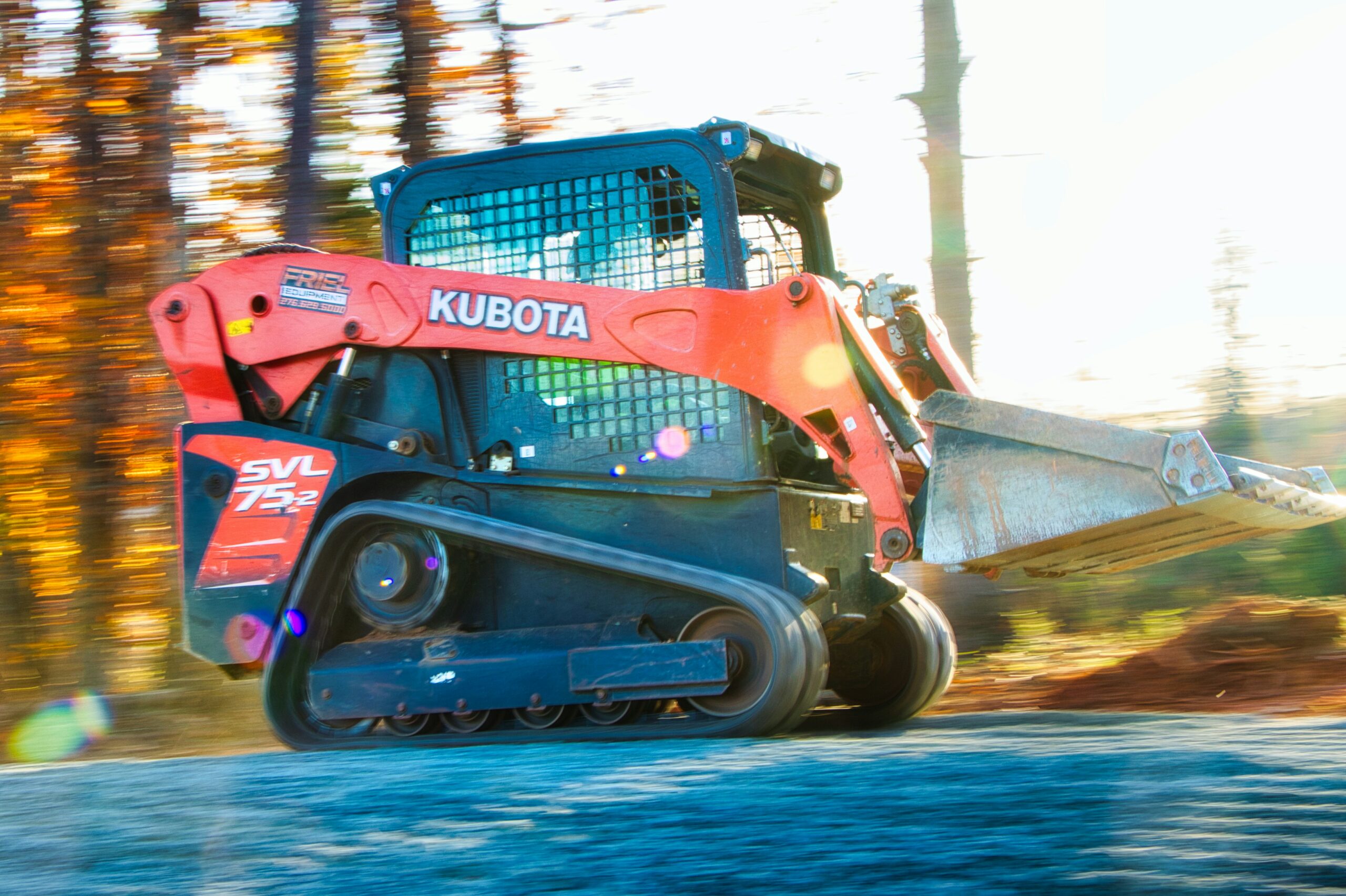
Most skid steer hydraulic problems get misdiagnosed in the first five minutes, because the owner treats the machine like a tractor with a loader bolted on. The Keller brothers built the first one in Rothsay, Minnesota, in 1957 to help a farmer clean turkey manure out of a barn, and the choice they made still trips people up: the hydraulics run everything. Steering, travel, lift, tilt, attachment. No steering box, no gearbox to fall back on.
One Tank, Two Circuits That Fail Differently
A skid steer carries a closed-loop hydrostatic drive and an open-loop work system, and on most machines they share a reservoir, a suction line, and almost nothing else. The drive side runs high — upward of 6,000 psi — while boom, bucket, and auxiliary circuits sit between 3,000 and 5,000 psi. A Bobcat S650 runs a 23 gpm pump at 3,550 psi.
A member on TractorByNet laid this out well in a thread about weak loader and weak drive on the same machine: one two-section gear pump, one section feeding the loader, the other feeding steering and charge pressure, with only the reservoir and suction line shared. If both circuits are weak at once, look at what they share. Only one is weak; stop looking at the other.
So answer this first: does the machine drive fine while the loader is weak, does the loader work while the machine won’t move, or is the attachment the only lazy thing on it? Three answers, three very different repair bills.
The Machine Won’t Move but the Boom Still Lifts
This is charge pressure until proven otherwise, and it’s the check owners skip on their way to pricing a drive pump. The charge pump feeds the inlet of the hydrostatic drive pumps and replaces the oil they lose lubricating their piston shoes. When it drops off, the machine gets sluggish, worse at low idle, and eventually won’t pull — while the loader, on its own section of the pump, keeps working and convinces you nothing is wrong.
The numbers owners report are worth writing down. In a TractorByNet thread on charge pressure, a Bobcat T190 owner with roughly 2,200 hours found about 340 psi at full throttle against a T300 reading closer to 440, and a responder cautioned against dialing a lighter machine up to match a heavier one — excess charge pressure costs push power and makes heat. On an ASV HD 4500, an owner put the test port behind the filter access panel on the muffler side, spec’d at 280 to 320 psi at idle.
A hydraulic pressure test gauge kit turns “it feels weak” into a number you can hold against the service manual, and our tractor hydrostatic transmission guide covers the same logic on the tractor side.
Attachments feed into this too — a 2006 T300 owner rented a trencher, ran it about twelve hours, and afterward the machine started throwing code 05-14, extremely low hydraulic charge pressure.
The Filter Nobody Knows They Have
Everyone finds the main hydraulic filter in the rear engine compartment. Bobcat’s interval is 500 hours, and the element for an S630, S650, or T650 is part number 7002734.
The ones people miss are the case drain filters. Many track loaders and some skid steers filter the drive motor case drain lines separately, and the S300 carries two case drain assemblies in two locations. When one plugs, pressure rises inside the drive motor housing,g and the shaft seal is usually the first to let go. M-Series machines also hide a charge filter under the cab. If a machine drives weakly on one side, or has already eaten a drive motor, that’s where to look before condemning anything expensive. It cascades, too: a Case 75XT owner past 4,000 hours had both drive motors rebuilt and found one had sent metal debris through the system.
One service note: the S650 reservoir holds 2.7 gallons, but total system capacity is around 45 liters, so a drain-and-fill leaves most of the old oil in the pumps and cylinders. Our tractor hydraulic repair guide covers why a new pump in dirty oil doesn’t survive.
Only the Attachment Is Lazy
If the machine drives and lifts normally, the fault is in the auxiliary circuit, not the pump.
Standard-flow auxiliary hydraulics generally deliver 17 to 24 gpm at the same 3,000 to 3,500 psi the main circuits run; high-flow systems land between 27 and 45. Running a high-flow tool on a standard-flow machine is the trap, because it appears to work — slowly, oil climbing — and does damage before the operator concludes anything is wrong. These systems want to live between 140°F and 180°F; above that, seals harden, and varnish starts sticking valve spools.
Then there’s the third hose. A case drain line alongside the two auxiliary lines gives a motor’s leakage a low-pressure path back to the tank. Kinked, disconnected, or plumbed into a pressurized return, shaft seals fail fast — oil weeping at the motor face right after hookup is a stop-work signal. Never plug it because the tool still runs. And when you go hunting a leak, pass a piece of cardboard over the suspect area rather than your hand; ag extension safety guidance is blunt that injected hydraulic oil is an emergency room trip.
When the attachment does nothing at all, the cause is often electrical — a blown fuse or dead auxiliary solenoid. A multimeter at the solenoid connector answers that in a minute and saves tearing into a valve block that was never at fault.
Couplers That Won’t Go Back Together
Flat-face couplers won’t mate when pressure is trapped on the implement side, and it doesn’t take a mistake to get there — an attachment sitting in the sun expands its own oil. A Kioti 3510 owner running flat-face skid steer connectors on a third function reported he could never connect without unscrewing fittings to bleed both sides, while his Pioneer-style rear remotes gave him no trouble. The same coupler style shows up across the compact loader lines, including the machines covered in our Kioti skid steer problems guide. The fix owners describe across brands: shut the machine off, turn the key back to run so the circuit still has power, disengage the parking brake, then work the levers to bleed pressure to the tank. Relieve it before you disconnect, not after.
What Changed on the New Ones
Bobcat revealed seventeen next-generation loaders at ConExpo in March 2026, split into Classic and Pro lines, with the Pro machines carrying radar and camera object detection. Caterpillar’s 270 XE now runs the lineup’s highest output at 40 gpm and 4,496 psi. Higher flow makes attachment matching less forgiving, and more electronics moves the diagnosis toward sensors.
The Order I’d Check These In
- Which circuit is weak — drive, work, or auxiliary. Answer this before touching a wrench.
- Fluid level and condition, then filter history, including case drain and charge filters.
- Charge pressure on a gauge against the manual’s spec, not against feel.
- Oil temperature after twenty minutes of real work.
- For attachment complaints: flow rating, coupler seating, case drain routing, solenoid power.
Skid steer hydraulic problems get expensive when the first assumption is a pump. It rarely is. Most of what stops these machines is a filter, a coupler, a fuse, or a charge pressure reading three hundred psi low.