Zero-Turn Mower Problems: Stop Diagnosing It Like a Tractor
Some links here are affiliate links — if you buy through them, Dirt Road Mechanic earns a commission at no extra cost to you. It never affects which parts or tools we recommend. Full disclosure.
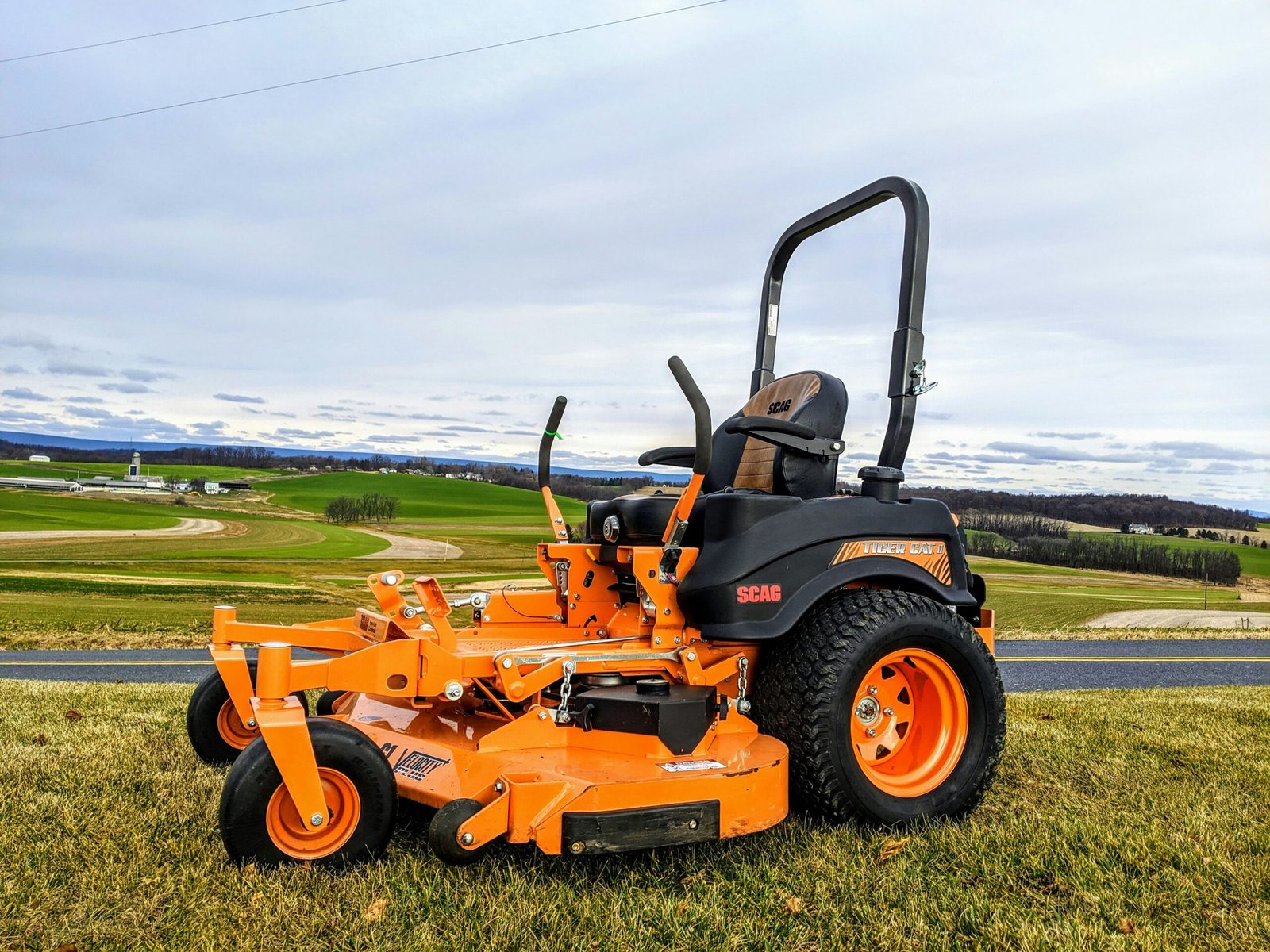
A zero-turn mower and a compact tractor share a lot of vocabulary — PTO, hydrostatic, clutch — and almost none of the actual hardware. Treat a zero-turn like a small tractor, and you’ll end up chasing the wrong repair, because nearly everything that goes wrong on these machines comes down to one of two systems, and both work differently than what’s sitting under a tractor’s hood.
The Drive Side Is a Transaxle, Not a Transmission
Most zero-turns run a Hydro-Gear ZT-2800, ZT-3100, or ZT-3400 on each side — an “integrated” transaxle, meaning the hydrostatic pump, motor, and gear case all live in one sealed housing. That’s a different animal from a compact tractor’s HST, where the transmission case doubles as the reservoir for the whole drivetrain and the brakes. On a zero-turn, each wheel has its own self-contained unit, which is exactly how the machine spins in place — one side drives forward, the other reverse, and the mower pivots around the middle.
It also means the fluid is different. A ZT-3100 wants 20W-50 motor oil, not Kubota UDT2 or John Deere Hy-Gard — pour tractor hydraulic fluid into one of these, and you’re using the wrong spec for a sealed unit that was never built to share fluid with a transmission, a differential, and wet brakes the way a tractor’s is. First service comes at 75–100 hours, then every 200–400 hours after, through an external spin-on filter that makes the job quick once you know where it sits.
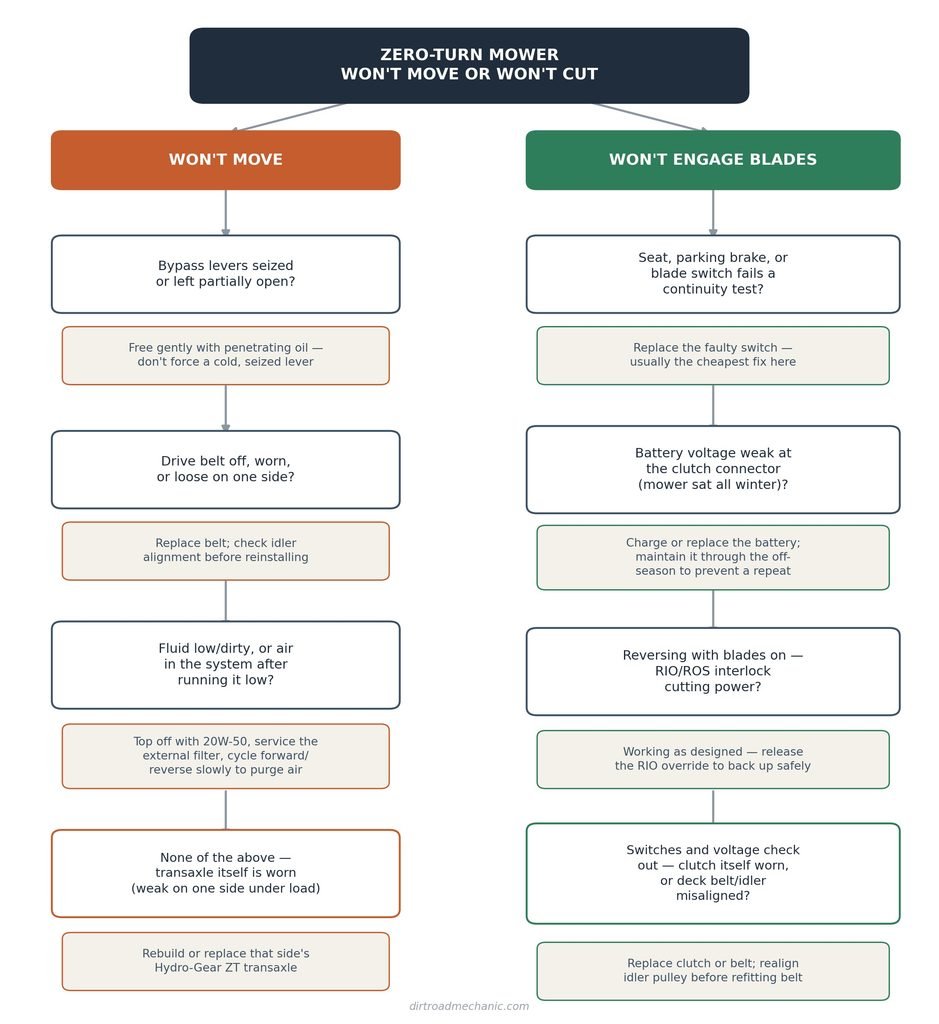
Symptoms sort out fast. Weak on one side only, or the mower pulling to one direction, points at that side’s transaxle or its drive belt tension — not the whole system. No movement at all? Check the bypass levers first; they’re what let you push the mower by hand, and if one’s left partially engaged or seized from sitting all winter, the mower won’t drive right even with a healthy transaxle. A stuck lever responds to penetrating oil worked in gently — don’t force it cold. Jerky or hesitant movement after the mower’s sat with low fluid usually means air got into the system; running it through a few slow forward-reverse cycles typically clears it once the fluid’s topped off.
What you won’t find on most of these: a charge-circuit pressure port to test, the way you would on a Kubota. These integrated units aren’t built for a field pressure check — the diagnostic order is fluid condition, filter, belt, and bypass valve, not a gauge.
Blades Won’t Engage? Follow the Switches Before the Clutch
The electric PTO clutch on the deck — often a Borg-Warner unit — gets blamed first and is wrong more often than it’s right. Before it, there’s a chain of safety switches: seat, parking brake, and the blade switch itself, all of which have to agree before the clutch gets power at all.
An owner on TractorByNet traced an engine-dies-when-I-engage-the-blades complaint on a Gravely PM260Z back to that exact chain — isolating the brake switch, then the seat switch, then the PTO switch one at a time until the culprit turned up. That’s the right order to work in: a multimeter on each switch for continuity finds a bad one in minutes, versus buying a new clutch and finding out it wasn’t the problem.
A weak battery causes the same symptom and gets missed constantly, especially on a mower that sat all winter — the clutch coil needs real voltage to pull in, and a battery that’s been trickling down since October often has just enough charge to crank the engine but not enough to engage the blades reliably. It’s the same voltage-drop logic covered in our tractor electrical problems guide, just applied to a clutch coil instead of a starter. A battery charger that can maintain it through the off-season heads this off before it turns into a spring diagnostic.
Most zero-turns built in the last couple of decades also carry a reverse safety interlock — Reverse Implement Option, or Reverse Operation System on Husqvarna’s machines — that cuts blade power, or the whole engine, if you back up with the blades running. It’s required under ANSI/OPEI safety standards, and it trips up more owners than you’d expect, since backing up mid-mow with the blades on feels like it should just work.
When the Belt and Pulleys Are the Actual Problem
Not everything on the deck side is electrical. A TractorByNet thread titled simply “Zero Turn Mower Problems” has an owner asking whether to run the OEM Borg-Warner clutch on a Bobcat FastCat Pro or a cheaper equivalent, after noticing the idler pulley sitting off-center — worth checking before any belt goes back on, since a misaligned idler chews through a new belt fast. Further down the same thread, a different owner describes replacing a PTO clutch two or three times on a Ztrak 757 before finding the actual cause: a leaky muffler pointing hot exhaust straight at the clutch, cooking the coil packs each time. The clutch kept failing because something else was killing it, not because the clutch itself was bad.
Aftermarket clutches, a few owners in that same thread note, can grab harder and faster than the factory unit — which has been known to snap belts that held up fine under the original.
Connectors on the clutch and interlock switches take a beating from wet grass and dew that a tractor’s harness rarely sees in the same way. Dielectric grease on those connections whenever you’re back in there for something else is cheap insurance against the corrosion that causes intermittent, hard-to-chase faults.
Check for an Open Recall First
Before troubleshooting anything, it’s worth five minutes to check for a recall by serial number. Spartan Mowers recalled certain 2025 model-year SRT-XD and KGZ-XD units in late 2025 over a steering damper defect that can keep the control levers from returning to neutral. In January 2025, about 39,000 John Deere ZTrak mowers with Kawasaki engines were recalled after a voltage regulator that could overheat and start a fire. Bobcat- and Kubota-branded stand-on zero-turns were recalled in October 2023 for a similar damper problem affecting the operator-presence shutoff. All three are checkable through the manufacturer’s site before you spend an hour chasing something that’s actually a known defect.
Start With What’s Free to Check
Battery voltage, switch continuity, fluid level, and belt condition cost nothing but a few minutes, and they resolve most zero-turn mower problems before you’re staring down a clutch or transaxle bill. The clutch and the transaxle are real failure points too — they’re just not where the money should go first.
FAQ
Why does my zero turn die the second I engage the blades? Almost always one of the safety interlocks — seat, brake, or the blade switch — reading a condition it doesn’t like, or a weak battery that can’t hold voltage once the clutch coil draws power.
Can I use tractor hydraulic fluid in the transaxle? No. These are sealed Hydro-Gear units built around 20W-50 motor oil, not the UDT2 or Hy-Gard spec a tractor’s shared-sump HST needs.