Kioti Skid Steer Problems on the SL750 and TL750
Some links here are affiliate links — if you buy through them, Dirt Road Mechanic earns a commission at no extra cost to you. It never affects which parts or tools we recommend. Full disclosure.
Kioti skid steer problems are hard to research honestly, because most of what’s written about these machines was produced by people who’ve never stood next to one. The SL750 and TL750 have only been on the market a few years, so the truthful answer to “what goes wrong with these” is shorter than you’d like — and more useful than a padded list of ten failures that would fit any loader ever built.
The Lineup Is Two Machines, and the Names on Dealer Lots Aren’t Real
Kioti’s entire compact loader line is two machines. The SL750 is the wheeled skid steer, the TL750 is the tracked version, and underneath they’re the same machine: a 74-horsepower Kioti four-cylinder turbodiesel, Tier 4, vertical lift path, two-speed travel standard.
The confusion starts on the sales lot. You’ll see listings for an “SL750V XR Edition” or a “TL750V XL3 Edition” and reasonably assume those are separate models with different specifications. They aren’t. Those are dealer option bundles — a self-leveling 4-in-1 bucket, walk-through forks, a hydraulic quick-attach coupler, a Quiet-Cab II package — assembled and named by the selling dealer. Kioti builds an SL750 and a TL750. Everything after that is trim.
The Weak Spot Isn’t the Steel
Ask somebody who’s put real hours on one, and you get a consistent answer: the machine is fine, the support behind it isn’t.
A TL750 owner on TractorByNet, who also runs a Kioti NS4710 cab tractor, put it about as plainly as it can be put — Kioti is built just as well as Kubota, John Deere, Bobcat, and the rest, and the biggest problem is the lack of resources. No parts diagrams, schematics, or exploded views published online the way other manufacturers publish them, and longer lead times on some parts because the US network isn’t built out to the same depth. Filters and routine service items he had no trouble getting. That’s a real cost, and the kind that stays invisible until you’re already broken down.
It gets worse the further out you go. A March 2026 thread on TractorByNet — 41 replies, roughly 7,000 views — was started by an owner whose KL402 loader joystick support bracket had broken for the third time in sixteen years. Kioti had discontinued the part because the model was more than ten years out of production. His dealer couldn’t order one. There were none in Canada. The rep he reached couldn’t escalate it to anyone.
That’s a tractor loader, not a skid steer — but it’s the same parts organization behind both, and a fair preview of what a ten-year-old SL750 is looking at.
What Has Actually Gone Wrong
The documented list is short. Here’s what’s on it.
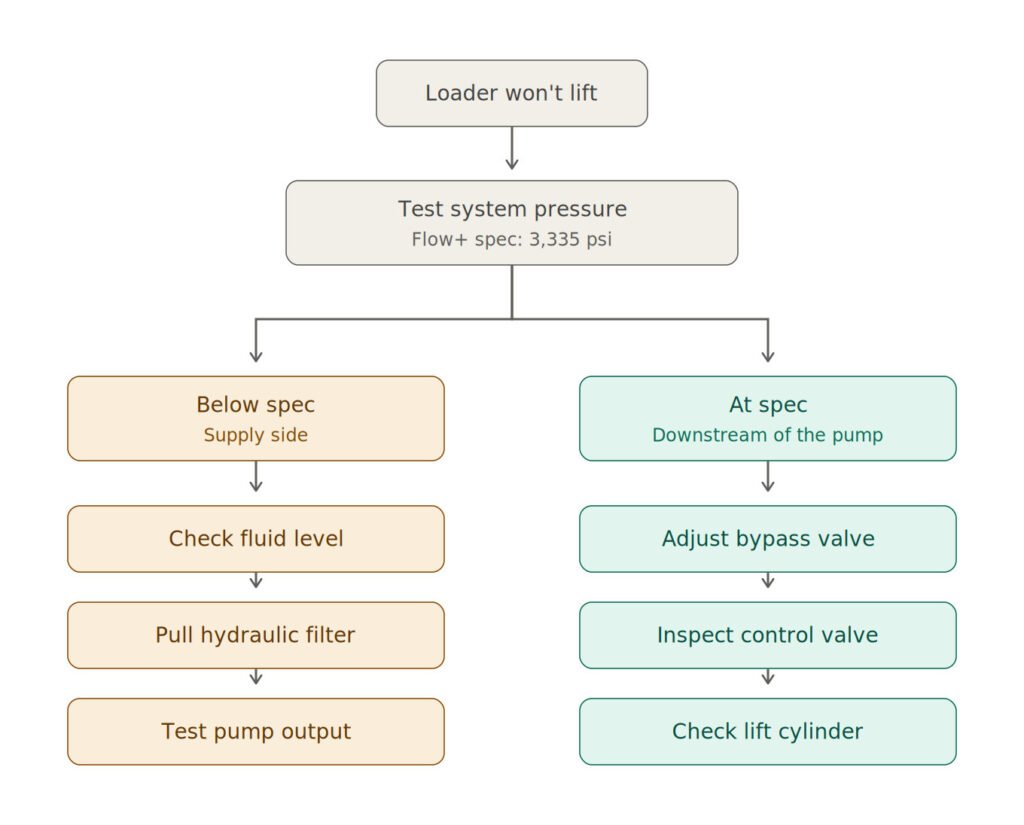
The loader stopped lifting. A 2024 TL750 with 180 hours on it — moving dirt, running a CDI Tree Reaper — quit lifting one time. The dealer adjusted the bypass valve, and that was the end of it. Not a pump, not a cylinder. An adjustment. So if yours stops lifting, check that before anybody quotes you for a pump. A hydraulic pressure test gauge kit tells you whether the system is making rated pressure first — the TL750 with Flow+ is spec’d at 3,335 psi, so there’s a real number to check against. Our tractor hydraulic repair guide covers the process.
The air conditioning compressor. Same owner, on his cab tractor rather than the loader: the compressor locked up twice, both replaced under warranty. The compressor wasn’t the problem. The condenser packs with dust, runs hot, and takes the compressor down with it. He started cleaning it out with an air comb and hasn’t had another failure.
A regen code that wasn’t a regen problem. The machine threw a DPF temperature sensor fault that blocked regeneration. The cause was a dirty fuel filter — the engine couldn’t pull enough fuel to burn hot enough to finish the cycle. He’d also been doing a lot of low-rpm work, and these engines want to be run up. Our tractor overheating guide covers how light-duty operation interferes with regen.
Loose fasteners out of the crate. Most of that owner’s early trouble was traced to dealer prep rather than anything Kioti did — things not properly tightened during assembly, which the dealership’s owner admitted was one employee not doing the job. Good reason to go over a new machine yourself in the first few hours.
The One Decision You Can’t Undo
Standard flow or Flow+. Get this wrong, and you live with it.
That TL750 owner bought the low-flow model and runs a tree cutter with it. It works, but under heavy cutting the hydraulics bog, and he wouldn’t attempt a drum mulcher. Another owner in the same thread was blunter — get high flow regardless, because it widens what you can run and protects resale.
Flow+ on the TL750 runs 22 gpm at 3,335 psi. If there’s any chance you’ll want a mulcher, a cold planer, or a snow blower down the road, buy that version. Adding it later means trading the machine.
Looking at a Used SL750 or TL750
Pull the condenser cover and look at the fins. Packed solid means the last owner wasn’t cleaning them, and the A/C system has been cooking.
Cycle the loader through full lift several times, watching for hesitation near the top. A bypass valve adjustment is cheap, but find it before money changes hands.
Confirm the flow package on the machine, not from the listing — those dealer edition names won’t tell you.
Then ask where the seller got parts. Owners with a strong local dealer describe a different experience from owners without one. On this brand, that matters more than the hour meter.
Questions People Actually Ask
Are Kioti skid steers any good? By the accounts available, yes — build quality holds up against the major brands, and owners who push them hard report they take it. The reservation isn’t the machine; it’s how fast you can get a part for it ten years from now.
Who makes Kioti skid steers? Kioti is the tractor division of Daedong-USA, a subsidiary of Daedong Corporation in South Korea. The engine in both loaders is Kioti’s own — the same one used in the RX Series tractors, worth knowing if you already run one and want to compare against documented Kioti tractor problems.
One last thing worth saying out loud: this lineup is only about three years old. No high-hour failure data, no recall history, no pattern of known defects — not enough of these machines have put on enough hours yet. Any page listing ten common Kioti skid steer problems invented most of them. The short, cheap, fixable list above is the honest inventory, and what you’re really weighing is whether your dealer is good enough to cover for a parts network that isn’t finished being built.