John Deere Tractor Problems: What Breaks and Who Can Fix It
Some links here are affiliate links — if you buy through them, Dirt Road Mechanic earns a commission at no extra cost to you. It never affects which parts or tools we recommend. Full disclosure.
John Deere tractor problems have always come in two flavors, and for the last decade, which one you got had less to do with what broke than with what year your machine was built. A bad ground on a 4020 is a bad ground — find it, clean it, move on. The same fault on a newer common-rail machine can drop the tractor into a crawl and keep it there, and until a couple of weeks ago there was exactly one place you could go to fix that. Between a July settlement and a recall still working through the compact lineup, here’s what’s actually different now.
The Split That Explains Most John Deere Tractor Problems
Forget symptom lists for a minute. The useful dividing line on a green machine is the emissions era, not the model number.
Pre-2011 tractors are mechanical top to bottom — injection pump, glow plugs, wiring, hydraulics, all of it diagnosable with a test light and a manual. When folks talk about Deeres running forty years, this is what they mean.
From roughly 2013 on, Final Tier 4 changed things, but not evenly, and that’s where most articles get it wrong. The little compacts largely dodged the mess. A 1025R runs a 1.267-liter three-cylinder Yanmar with indirect injection and no turbo, making 23.9 gross horsepower — under 25 hp, the emissions rules are light, and no DPF is waiting to ruin your Saturday. Step up one series to a 3038E, and you get a turbocharged Yanmar with common rail and an ECU adjusting fuel delivery on the fly. Same lot, same paint, two different ownership experiences.
What Actually Changed on July 8
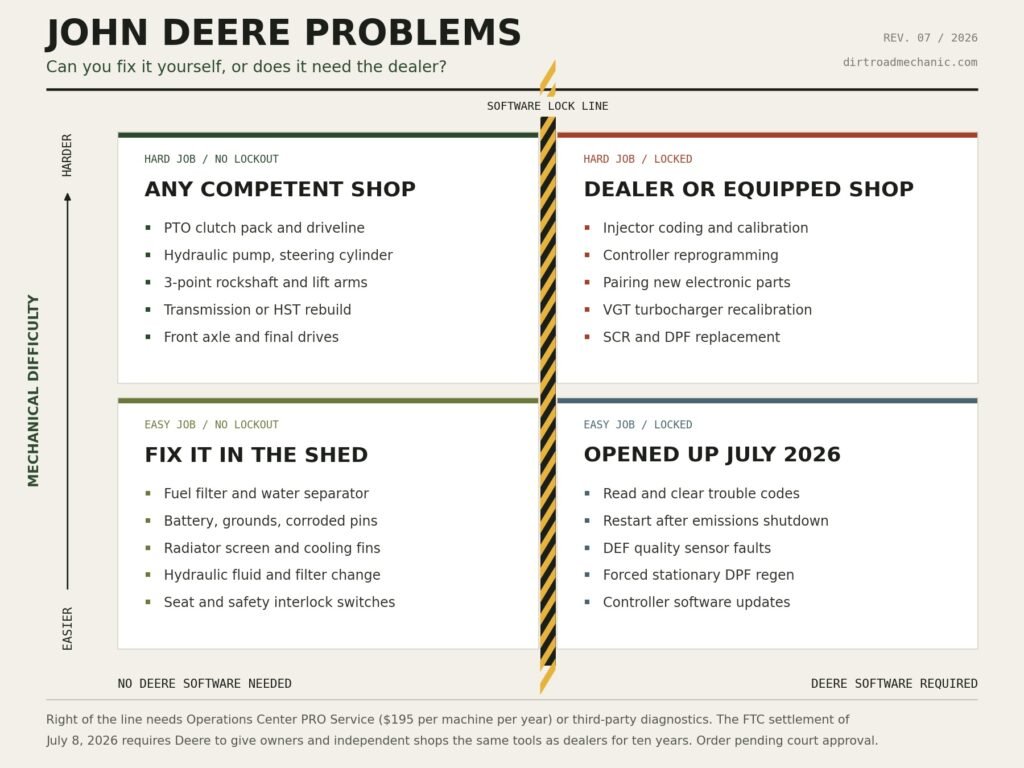
On July 8, 2026, the FTC and five states settled their antitrust suit against Deere. For ten years, under federal supervision, Deere has to give farmers and independent shops the same repair resources — software included — it hands its own dealers, and dealers can’t retaliate against you for doing your own work.
That last part isn’t boilerplate. Deere made the only software capable of every electronic repair on its own machines and kept it in-house. When a 333G owner posted about DEF codes and a derated engine, the answer was blunt: those codes derate the machine on their own, and clearing them takes a dealer connection.
Now the catch: if you’re on a subcompact. A second case — the $99 million class action Deere settled in April, with no admission of wrongdoing — covers 6000 through 9000 Series tractors, combines and harvesting gear. Own a 1025R? You’re not in it. The FTC settlement is broader, but pieces are still rolling out this year, so don’t plan next spring around tools you haven’t put hands on yet.
That’s the short version. For the full breakdown of the $99 million settlement, what Operations Center PRO Service actually costs and unlocks, and whether it’s worth it for a DIY owner, see our John Deere tractor repair guide.
The Bell Crank Recall Is Still the Real Story for Compact Owners
While everyone watched the lawyers, roughly 147,900 compact utility tractors in the U.S. sat under a CPSC recall — 1023E, 1025R and 2025R units sold between November 2017 and July 2024 — over a brake linkage bell crank that can crack and let go.
The Green Tractor Talk thread runs past thirty pages and is worth more than the recall notice. One 2017 1025R lost its brakes in the driveway, and the owner had a shop fabricate a steel replacement rather than fit another like it. The original appears to be cast pot metal — owners noted theirs weren’t even magnetic — while replacements went to steel.
The rollout was rough. A stop-sale order kept dealers from moving affected used machines, one owner’s dealer group had two replacement parts total across all its stores, and plenty of people spent a winter told not to run a tractor they needed for snow.
Two notes from that thread. The part is LVU31387, and the 1023E uses the same one as the 1025R — the earlier 1026R does not, so don’t assume. And watch your differential lock afterward: more than one owner found it engaging constantly once the new piece went on, which is a linkage adjustment, not a failure. Doing the bolts yourself? Soak them first with PB Blaster — access back there is miserable, and folks have burned an hour on two fasteners.
Fixing the Problems That Actually Come Up
Cranks but won’t fire. On the Yanmar-powered compacts, this is usually air in the fuel, not a bad injector. Bleed at the filter housing first, then at the pump, and confirm the fuel shutoff solenoid clicks when you turn the key — put your ear near it, and you’ll hear it.
Engine dies when you stand up, or the PTO won’t engage. Deere ties the seat, brake, and PTO switches into one interlock circuit, and the seat switch under the cushion is usually the culprit — its connector sits right where water collects. Unplug it, look for green on the pins, and pack it with dielectric grease before it goes back together.
Hydraulics slow, loader sluggish, HST weak until it warms up. Nine times out of ten that’s fluid, not the pump. Hy-Gard comes in standard and low-viscosity versions, and running standard in cold country makes a healthy machine feel like it’s dying every morning.
Loader or 3-point drifts down overnight. That’s an SCV or rockshaft seal, not the cylinder. Cycle the valve fully both directions a few times first — trapped air mimics a leak well enough to fool people into buying parts.
Power falls off and won’t come back (Final Tier 4 machines only). Usually an interrupted regen. Park it, set high idle, and let a stationary regen run to completion; shutting down mid-cycle is what stacks the counts that eventually derate the engine. Check your DEF too — it has roughly a year of shelf life, and old fluid throws quality faults that read like sensor failures.
What This Means For You
Run your serial number. Deere’s recall and Product Improvement Program lookup shows what’s open on your machine in about ten minutes, and it covers more than the brake issue.
Don’t over-plan around the settlement. On a 6R or a combine, the door is genuinely opening. On a subcompact, most of what breaks was never behind software anyway.
Buy the right consumables. Hy-Gard in the correct viscosity, an AM125424 filter, and HD lithium grease on the brake and 3-point pivots — all cheap next to one diagnostic hour.
See also our guides on why a John Deere won’t start, John Deere hydraulic fluid, 3-point hitch problems, and Yanmar tractor problems for the engines in the compacts.
FAQ
Are John Deere tractors reliable? Broadly yes, but reliability tracks the build year more than the badge. Pre-2011 machines keep running on basic maintenance. Common-rail Final Tier 4 tractors are capable but carry hardware that can sideline one over a single sensor. Subcompacts under 25 hp mostly skip that.
Can I fix my own John Deere now? More than you could a month ago. The July 2026 FTC settlement requires Deere to sell owners and independent shops the same repair resources and software its dealers get, for ten years, and bars dealers from retaliating. Some of it is still rolling out.
Is there a recall on the John Deere 1025R? Yes — roughly 147,900 compact utility tractors, covering 1023E, 1025R and 2025R models sold November 2017 through July 2024, over a brake bell crank that can break. The repair is free through a dealer. Run your serial number to confirm.
The short version on John Deere tractor problems in 2026: the failures haven’t changed much, but who’s allowed to fix them finally has. Sort out which era your machine belongs to and get the serial checked.
What’s your take on this? Drop it in the comments.