New Holland Tractor Won’t Start? Check the Solenoid Before You Touch the Fuel Filter
Some links here are affiliate links — if you buy through them, Dirt Road Mechanic earns a commission at no extra cost to you. It never affects which parts or tools we recommend. Full disclosure.
When a New Holland tractor won’t start, the part that gets replaced first is rarely the part that failed. Owners work through filters, injection pumps, and batteries over a span of weeks, and the actual fault turns out to be a circuit problem findable in ten minutes with a jumper wire. Blue tractors fail in a few specific, repeatable ways.
The Two-Second Dropout Everybody Misdiagnoses
On Shibaura-powered compacts — the TC and TZ series, the older Boomer numbers, the Workmaster 45 and 55 — fuel flow runs through an energize-to-run shutoff solenoid with separate pull and hold circuits. When the hold side quits, the solenoid yanks in on key-on, then falls back out a couple of seconds later.
The symptom is unmistakable once you know it: the engine cranks, fires, runs for a beat, and dies. Every time. A Boomer 37 owner on TractorByNet documented it precisely — with the solenoid pulled from the block and still wired in, turning the key retracted it, and it released again in roughly two to three seconds.
That reads exactly like fuel starvation, which is why people go after filters and lift pumps. It isn’t. It’s an electrical fault in a fuel component.
The part is New Holland SBA185206083, with SBA185206084 and SBA185206085 as close relatives, cross-referencing to 87761614 and 281552A1. One solenoid family covers TC18 through TC55DA, TZ18DA through TZ25DA, Boomer 1020 through 4060, the T1010–T2420 range, TT45A and TT50A, and Workmaster 45 and 55.
Wire Straight to It and Listen
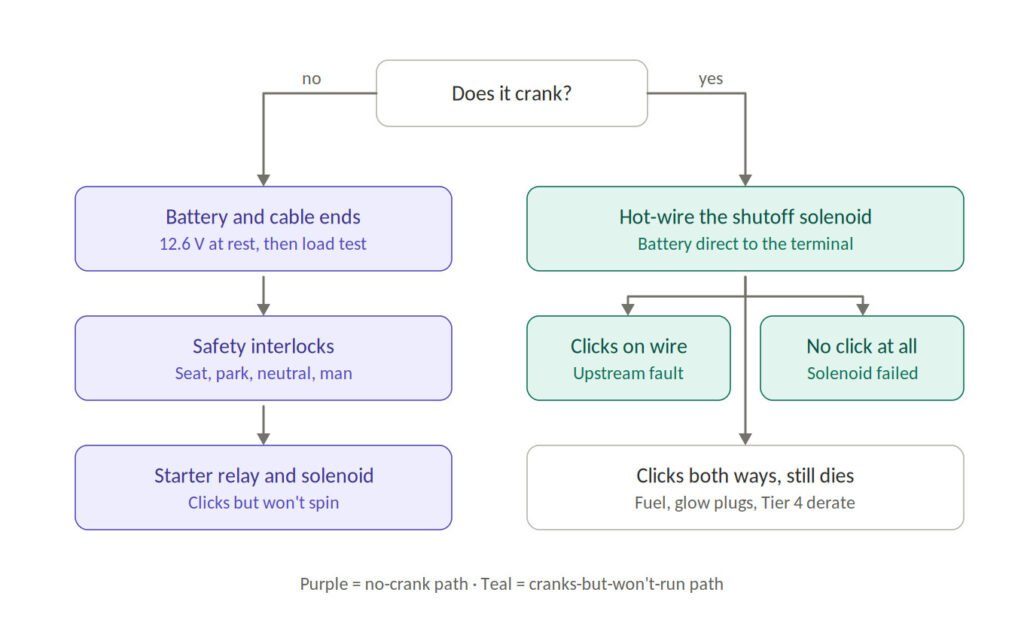
Run a wire from the battery positive post directly to the solenoid terminal and listen for the click. That bypasses every relay, fuse, and safety switch in one move.
Clicks on the direct wire but not on the key? The solenoid is fine — the fault is upstream in the relay or interlock circuit. No click either way? The solenoid is dead. One test, two outcomes, and the search area just got cut in half.
Verify with a meter rather than by ear. A Fluke 115 tells you whether voltage actually reaches the solenoid terminal with the key on. If the trail leads back into the harness, the hunting method in our guide to tractor electrical problems takes over from there.
Four Switches, and the Newer Dashes Name the Culprit
New Holland runs more start interlocks than most brands. A TT60 owner posting on Yesterday’s Tractors found four separate safety switches — three two-pin connectors and one four-pin.
The useful part is that Workmaster-generation machines report which one is unsatisfied. An owner of a 2015 Workmaster 60 described the display throwing warnings for “man,” “seat,” “park,” and “neutral” with no power reaching the starter. Most brands make you hunt. This one tells you.
| Indicator | What it’s watching | Where to look first |
|---|---|---|
| SEAT | Operator presence switch under the cushion | Connector under the seat pan, cushion mounting |
| PARK | Park brake position switch | Brake linkage adjustment, switch plunger |
| NEUTRAL | Transmission or shuttle in neutral | Shuttle lever detent, range lever position |
| MAN | Manual override/control lever position | Loader joystick, hydro pedal centering |
Several lights at once point at a shared circuit or ground, not four dead sensors. And if the machine cranks strongly but never catches, you’re already past the interlocks — next stop is the solenoid test above or a starter spinning without engaging.
Dies While Running Is a Different Problem
The seat switch carries a shutdown timer. Come off the seat over a bump, and if the switch doesn’t remap within a few seconds, the engine cuts out. Discussion on TractorByNet puts that window around three to four seconds.
That produces a complaint sounding nothing like a no-start: the tractor dies at random on rough ground, then restarts fine. Chasing it as a fuel problem is a dead end.
Know Which Engine You Actually Own
TractorData lists the Workmaster 40, built 2017 through 2025, with an LS Mtron 1.9-liter three-cylinder — Korean, not Japanese. The older TC 40 ran a Shibaura four, a distinction owners draw explicitly. Same brand, same rough horsepower, different engine entirely.
So the solenoid story above does not apply to a Workmaster 25, 35, or 40. Order the Shibaura part for one, and you’ll have the wrong component in hand. Engine sourcing shapes more than starting faults, which is why it turns up in our rundown of common New Holland tractor problems.
TractorData also lists the Workmaster 40 as the basic variant, the Boomer 40 as premium, and the Case IH Farmall 40A as the equivalent red machine. When Workmaster threads run dry, Farmall A threads cover the same tractor.
Tier 4 Machines Fail Somewhere Else
Split your thinking at the emissions line. Pre-emissions machines fail at solenoids, interlocks, glow plugs, and corroded cable ends. Tier 4 machines — Boomer 40 and up, the Workmaster line, the T-series — add soot loading and derate. One Boomer 37 owner chasing a no-start found the exhaust particulate elements completely packed, with replacement quoted around $1,500.
Cold-start hardware is a sore spot here too. Workmaster 35 and 40 manuals reference a cold starting aid indicator light that owners report they cannot find on the dash, and glow relay MT40007191 has been reported as no longer available.
Yes, You Can Read Your Own Codes
New Holland sells the Electronic Service Tool directly to owners, which is more than several competitors do. The twelve-month license, catalog number SRV03, covers brand vehicles from 1998 to the present and includes fault code retrieval and clearing, plus schematics.
The catch is hardware: it wants a true nine-pin serial port or an FTDI-chipset USB-to-RS-232 adapter, New Holland part 380003514. Generic dongles frequently won’t talk to it. And sub-25-horsepower machines often have no diagnostic port at all — the same trap that catches people shopping for a tractor diagnostic scanner.
Owning that path matters more than it used to. In May 2026, Ag Equipment Intelligence reported CNH layoffs alongside a reorganization placing combined management over both the New Holland and Case IH dealer networks.
The Order I’d Work Through
Battery and cable ends first — a weak battery mimics half the faults on this page, and a NOCO Genius 10 settles the question overnight. Then the interlocks, which cost nothing to check. Then the direct wire to the solenoid. Then, and only then, anything involving fuel.
Two physical checks belong in there. Pull the relay panel cover under the dash and look for a loose five-blade automotive relay hanging on the harness — a TT60A owner traced a no-crank to exactly that, full of water from the tractor living outside. And pack every connector you open with dielectric grease before it goes back together.
Worth stating plainly, because owners ask: no open safety recall covers starting failures on these machines. The recall history in this size class runs to PTO and brake issues instead, and you can check any serial number against the CPSC listings yourself.
My tractor cranks but dies after two seconds. Is that the fuel pump? Almost certainly not. That timing points hard at the hold circuit on the shutoff solenoid. Do the direct-wire test before spending money.
Most of the time, a New Holland tractor won’t start because of a circuit, not a component — and circuits are cheap to test and expensive to guess at. The same order of operations carries across colors, which is why the John Deere no-start walkthrough works the same way on very different hardware.