
Kioti Tractor Won’t Start? The Box Under Your Seat Is Usually Why
Some links here are affiliate links — if you buy through them, Dirt Road Mechanic earns a commission at no extra cost to you. It never affects which parts or tools we recommend. Full disclosure.
When a Kioti tractor won’t start, the advice written for a Deere or a Kubota gets you halfway there and then quits working. Kioti routes the whole start circuit through one electronic module bolted to the side of the transmission, under the seat pan. Miss it, and you can spend a weekend chasing switches that are all fine — a recurring theme in our roundup of common Kioti tractor problems.
Crank or No Crank Splits the Whole Job in Half
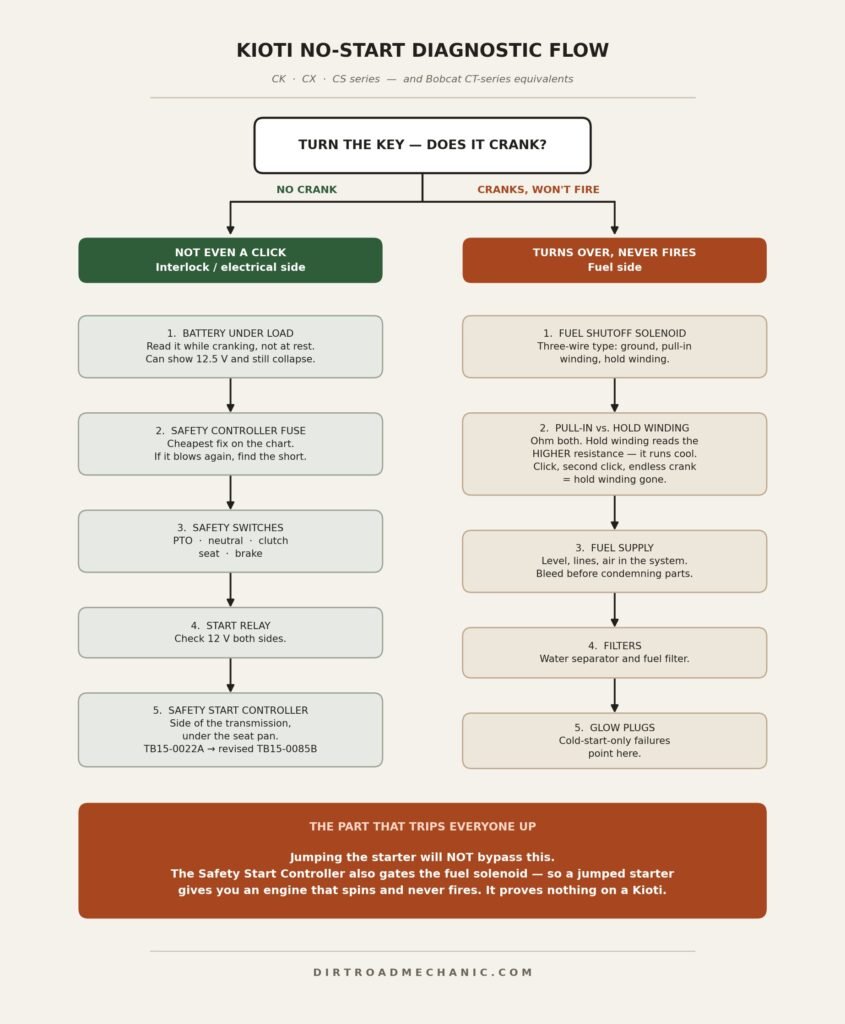
Turn the key and listen before you touch anything. If the engine turns over — even slowly, even if it never fires — the interlock circuit is doing its job and letting the starter run, and your problem is downstream in fuel or air or compression. Nothing at all, not so much as a click, puts you in interlock and electrical territory. A member of one Tractor Forum discussion on a CK2510 fuel stop solenoid put it plainly: on a newer Kioti, a tripped safety switch means it won’t turn over at all. If it’s cranking, stop looking at the seat switch.
Battery first. One can read 12.5 volts at rest and still collapse under load, so read it while someone cranks. A smart charger like the NOCO Genius 10 will recover a sulfated battery further than a trickle charger. If it cranks slow and drags rather than not cranking at all, that’s a different job — see replacing a tractor starter.
The Safety Start Controller Is the Part Nobody Tells You About
On CK, CX and CS machines there’s a module called the Safety Start Controller — or Safety Control Unit, depending on who you ask — mounted on the transmission below the seat pan. As a dealer explained it in a TractorByNet thread on Kioti no-start electrical faults, that controller reads every safety switch, determines glow plug timing, and sends the start signal to the start relay.
The consequence catches people out. On most tractors you can jump the starter solenoid and at least get the engine running to confirm the interlocks are your problem. On a Kioti you can’t — the same controller gates the fuel solenoid signal, so jumping the starter gets you an engine that spins and never fires, a point worked out the hard way in a CX2510 no-start thread.
Owners consistently report a few things worth knowing about this module:
- It has its own fuse. In that same CX2510 thread, the entire no-start turned out to be that fuse. A blown fuse is usually a symptom rather than the cause, so if it goes again you’ve got a short to find.
- There’s a superseded part number. A CK2510H owner tracked an intermittent warm-restart failure to the control box and reported the original unit, TB15-0022A, being replaced by a revised TB15-0085B. If a dealer quotes the old number, ask.
- Cab and open-station machines take different controllers. Straight from a dealer in the no-start electrical thread above.
The pattern that points here is the frustrating one: starts fine cold, refuses after it’s been run and shut off, then starts again after sitting a few hours. That CK2510H owner had checked the battery, relays, fuses, and every safety switch before landing on the module.
One warning: bypassing the seat switch is common, and it makes this diagnosis harder, because it removes a working input from a circuit you’re trying to read. If yours is bypassed, put it back before you start testing. Kioti publishes owner’s manuals free, and the wiring section is worth having open. If the fault turns out to be upstream of the start circuit, our guide to tractor electrical problems covers grounds, harnesses and charging.
When It Cranks and Cranks But Never Fires
If it’s turning over, the usual suspect is the fuel shutoff solenoid on the injection pump — and Kioti’s is wired backward from what people expect. Some tractors use an energize-to-stop solenoid, powered only for a few seconds after the key goes off. The three-wire type on many Kiotis works the other way. As explained in a TractorByNet thread on fuel shutoff solenoids, it has a ground, a pull-in winding live only while cranking, and a hold winding that keeps the fuel rack open once the key returns to run. Lose the hold winding,g and you get the symptom owners describe over and over — in that same CK2510 solenoid thread, a loud click when you turn the key, a second click a beat later as the solenoid drops closed, then cranking all day with nothing.
Testing it takes a meter. Ohm the two windings — the hold winding reads higher resistance, since it draws less current and runs cool. A decent multimeter like the Fluke 115 earns its keep here; you’re chasing millivolt drops and small resistance differences, and a cheap meter will lie to you.
A Bobcat CT230 owner documented the full repair on TractorByNet: solenoid E6820-60011 plus harness adapter T2185-6938S001 for the three-pin connector, roughly $128 in parts, thirty minutes to install after about two hours of troubleshooting.
While you’re in there, check the safety switch connectors. Corrosion at a spade terminal mimics a failing module exactly, and it’s free to rule out. A dab of dielectric grease after cleaning keeps it from coming back. If the solenoid tests fine and it still won’t fire, work back through the fuel supply side — filters, air in the lines, bleeding.
Bobcat CT-Series Owners: This Is Your Article Too
Bobcat’s CT-series tractors were built by Daedong, Kioti’s parent, in Daegu, South Korea. The CT225, CT230 and CT235 share a frame, and per a contemporary CT235 review at Tractor.com, om the 1.6L 3A165LWM engine in the CT235 is the same powerplant Kioti put in the CK35. That review also notes Bobcat’s exit from the tractor business, with parts support continuing through the Kioti division — which is why that CT230 owner ordered his solenoid from a Kioti dealer.
So everything above applies. If you’re searching Bobcat part numbers and coming up empty, search the Kioti equivalent.
The Order I’d Check These In
- Battery voltage under cranking load, not at rest.
- Crank or no crank — this decides everything after it.
- No crank: the Safety Controller fuse, then the safety switches, then the module.
- Cranks but won’t fire: the fuel shutoff solenoid windings, then fuel supply and filters.
- Don’t jump the starter to “test” it. On this brand, it proves nothing.
Questions Owners Actually Ask
Where is the safety control module on a Kioti? On CK, CX, and CS models, it’s mounted to the side of the transmission under the seat pan. You’ll need to pull the seat and the pan to reach it.
Can I bypass the safety switches to get it running? You can bypass individual switches, but on this brand it usually won’t help — the module gates the fuel solenoid too. It’s a diagnostic step, not a repair.
Is a scan tool any use here? Not for this. Tractors use J1939 with a nine-pin Deutsch connector rather than automotive OBD2, and a start-circuit fault on a compact Kioti isn’t something you read codes for anyway.
The short version is that a Kioti tractor won’t start for the same handful of reasons anything else won’t — but the path to finding out runs through a module most troubleshooting guides never mention. Check the fuse before you order the box — it’s a two-dollar answer often enough to be worth the five minutes. Interlock logic is brand-specific enough that the same walkthrough doesn’t transfer; if you’re on a different machine, start with John Deere or New Holland instead.