Tractor Steering Problems: What’s Causing Them and How to Fix It Right
Some links here are affiliate links — if you buy through them, Dirt Road Mechanic earns a commission at no extra cost to you. It never affects which parts or tools we recommend. Full disclosure.
A steering failure is worse than most mechanical problems because it happens while you’re moving. On a slope or in a tight space, your options for stopping get very limited very fast. What you can safely diagnose yourself depends entirely on which of two steering systems your tractor has — and most owners don’t know which one they’ve got until something goes wrong.
The Two Steering Systems — and Why It Matters for Diagnosis
Most farmers know their tractor has power steering. What few know is that there are two fundamentally different ways that power steering works on a tractor, and they fail in completely different ways.
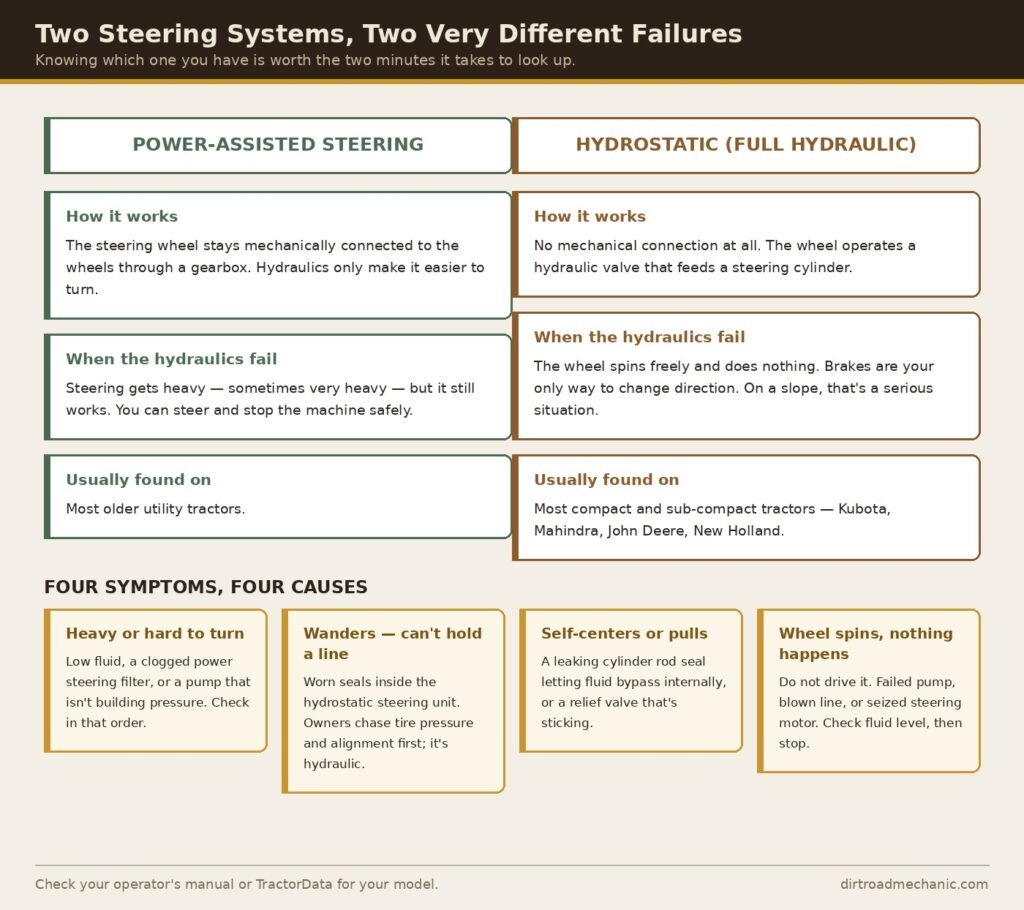
Power-assisted steering uses hydraulics to make turning easier, but the steering wheel is still mechanically connected to the wheels through a steering gearbox. If the hydraulic assist fails, the steering gets heavy — sometimes very heavy — but it still works. You can still steer and stop the machine safely.
Hydrostatic steering (also called full hydraulic steering) has no mechanical connection between the steering wheel and the wheels at all. The wheel operates a hydraulic valve that directs fluid to a steering cylinder. If the hydraulic system fails, the steering wheel spins freely and does nothing. Your only option to change direction is to use the brakes. On a hillside or in a tight space, that’s a serious situation.
Knowing which system you have before you have a problem is worth the two minutes it takes to look it up. Most compact and sub-compact tractors from Kubota, Mahindra, John Deere, and New Holland use hydrostatic steering. Most older utility tractors use power-assisted steering. When in doubt, check your operator’s manual or look up your model on TractorData.com.
Four Failures That Cover Most of It
Across both steering systems, the same handful of issues account for the vast majority of what shows up in the field.
Heavy or hard steering is the most common complaint on TractorByNet and MyTractorForum. In most cases, it traces back to one of three things: low hydraulic fluid, a clogged power steering filter, or a failing hydraulic pump that isn’t building enough pressure. A TractorByNet thread from February 2026 documented a JD 4410 owner with hard left-turn steering that stumped multiple mechanics — the root cause turned out to be a collapsing rubber suction hose between the two hydraulic pumps, not anything in the steering system itself. The hose was restricting flow under load, and only showed up as a steering problem when turning against resistance.
Steering wander — can’t hold a straight line is the signature failure of a worn hydrostatic steering unit. It’s the most commonly reported steering complaint on higher-hour Kubotas, and it comes from internal seal degradation in the steering unit. Operators describe it as having to constantly correct and counter-steer just to go straight — sometimes turning the wheel a full revolution to maintain direction. Most owners assume it’s a tire pressure or alignment issue before realizing it’s a hydraulic seal problem. It’s a safety issue, not just an annoyance, and it gets worse over time if not addressed.
Steering that self-centers or pulls to one side usually points to a worn steering cylinder rod seal or a sticking relief valve. If the cylinder seal is leaking, fluid bypasses internally, and the cylinder slowly creeps back to center. A sticking relief valve can bleed pressure to one side consistently, causing a pull. Both are diagnosable by checking whether the steering holds position when you let go of the wheel with the engine running.
No steering response at all — wheel turns freely, nothing happens — is a hydraulic failure on a hydrostatic system. Check the fluid level first. If fluid is fine, the problem is either a failed steering pump, a blown hydraulic line, or a seized steering motor. This is a do-not-drive situation until it’s fixed.
Tractor Steering Problems by Brand
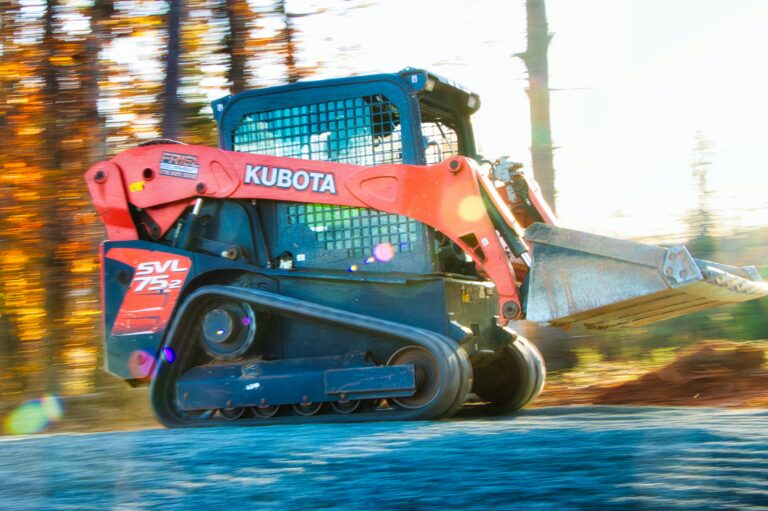
Kubota compact and utility tractors are the most documented for steering wander on aging machines. The hydrostatic steering unit wears internally over time, and Kubota Super UDT2 is the correct fluid spec for most models — running the wrong fluid accelerates seal wear. Keep the WIX 51372 hydraulic filter on your service schedule since a clogged filter starves the steering pump before it affects anything else. Our Kubota repairs guide covers the broader Kubota hydraulic picture.
John Deere compact tractors — particularly the 4000 and 5000 series — have documented steering issues tracing to the suction side of the hydraulic system rather than the steering components themselves. The F-shaped rubber hose connecting the dual pump sections is a known failure point — it collapses under load and restricts flow to the steering circuit. It’s a cheap part that requires some disassembly to access. For other brands that use universal trans-hydraulic fluid, TRIAX Agra UTTO XL meets the spec for most mixed-fleet or non-Kubota machines.
Mahindra and Korean-built tractors — a common concern on MyTractorForum — develop hard steering after the tractor has been sitting. Cold, thick fluid that hasn’t been changed in a while won’t flow fast enough to build pressure at startup. A fluid and filter change often solves what looks like a major steering problem. See our Mahindra tractor problems guide for more on Mahindra-specific hydraulic issues.
Working Through It, In Order
Before you pull any components, work through this order:
Step 1 — Check fluid level and condition. Pull the hydraulic dipstick or check the reservoir sight glass. Low fluid is the first cause to rule out. Dark, milky, or burnt-smelling fluid means you’ve got contamination or overheating — a fluid and filter service is your starting point, regardless of what else is wrong.
Step 2 — Check the power steering filter. Most tractors have a dedicated power steering filter separate from the main hydraulic filter. A plugged filter will cause hard steering before it causes any other symptom. Replace it and see if that resolves it before going further.
Step 3 — Pressure test the system. If the fluid and filter are good and steering is still hard, use a hydraulic pressure test gauge kit to check actual system pressure against spec. Low pressure points to a worn pump. Correct pressure with poor response points to the steering motor or cylinder.
Step 4 — Inspect hoses and fittings. Look for soft spots, cracks, or collapse in hydraulic hoses — especially suction-side hoses. A hose that looks fine externally can be collapsing internally under load. Squeeze it — it should feel firm.
Step 5 — Check cylinder rod seals. Look for hydraulic fluid weeping from around the steering cylinder rod. A leaking rod seal is a cheap fix that gets expensive if ignored — the cylinder bore can rust if the seal leaks long enough.
For any seized fittings or stubborn connections, PB Blaster soaked in ahead of time makes the job significantly cleaner. If your steering problems turned up alongside other hydraulic issues, our tractor hydraulic repair guide covers the full hydraulic diagnostic process.
Where to Start
Steering problems that get ignored don’t stay the same — they get worse. A steering system running low on fluid or with a failing seal is putting wear on components that are expensive to replace. Here’s the short version of what to do:
Know which steering system you have before you have a problem. Check your hydraulic fluid every time you do a walkaround. Change the power steering filter on schedule. If you notice any wandering, heaviness, or pulling developing, diagnose it before it becomes a safety issue. A pressure gauge tells you whether the pump is producing adequate flow before you replace parts that don’t need replacing.
FAQ
Why is my tractor hard to steer on one side but fine on the other? One-sided hard steering almost always points to a steering cylinder issue — either a leaking rod seal that’s causing the cylinder to lose pressure on extension, or a worn piston seal that bypasses internally under load. It can also be a clogged port in the steering valve, directing less fluid to one side. Start by checking for external leaks at the cylinder rod, then pressure test both sides.
How do I know if my tractor steering problem is the pump or the steering motor? Pressure test the system at the pump outlet. If pump pressure is at or above spec and steering is still poor, the problem is downstream — steering motor, cylinder, or valve. If the pump pressure is low, the pump is the issue. This one test splits the diagnosis cleanly and prevents the common mistake of replacing a steering motor when the pump was the problem all along.