Kubota Tractor Won’t Start: A Step-by-Step Diagnosis for BX, B, L, and M Models
Some links here are affiliate links — if you buy through them, Dirt Road Mechanic earns a commission at no extra cost to you. It never affects which parts or tools we recommend. Full disclosure.
When your Kubota tractor won’t start, the first thing working against you isn’t the tractor — it’s the internet. Type the symptom into Google, and you get generic diesel advice from folks who’ve never had an orange machine in the shop, half of it aimed at emissions hardware your tractor doesn’t even have. That’s how a $90 part turns into a $400 afternoon. Here’s what’s actually different on a Kubota — the part that fails most, the circuit that fools people, and the question to answer before you read another word about regens. (Running green instead? The John Deere version of this problem works differently.)
When Your Kubota Tractor Won’t Start, Listen Before You Wrench
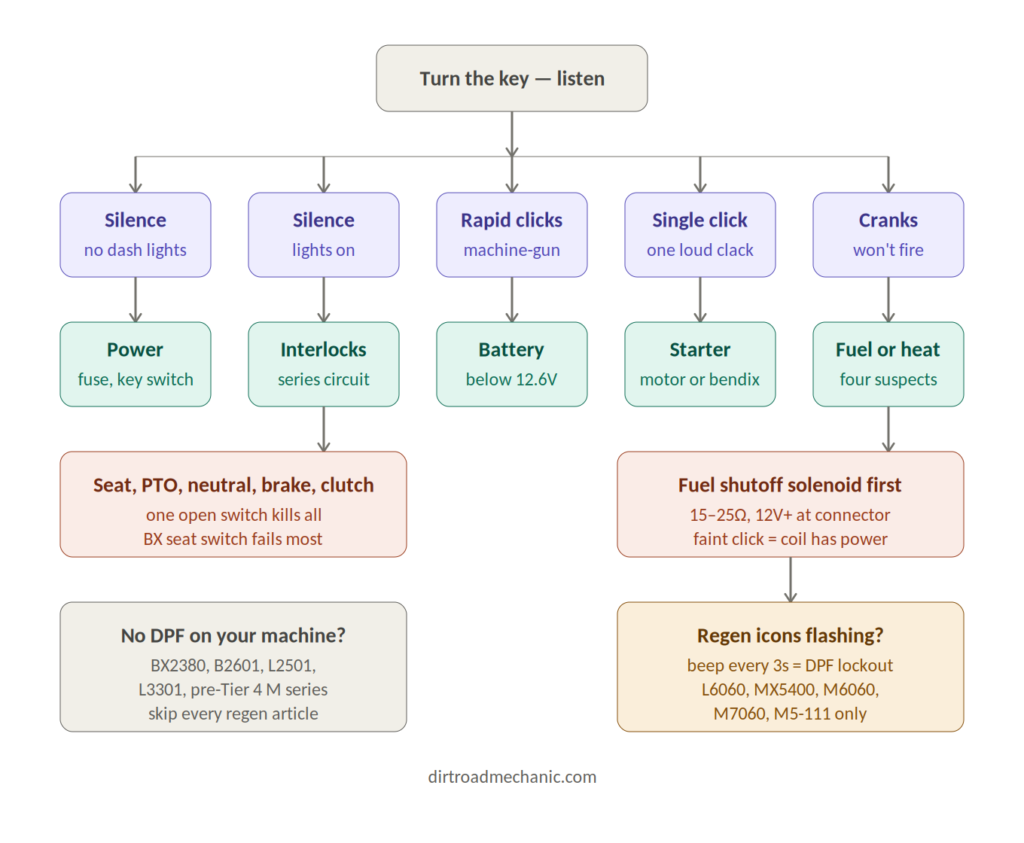
Before you pop the hood, turn the key and listen. Kubota no-starts sort by sound, and thirty seconds saves an hour. Silence with no dash lights is a power problem — main fuse, key switch, dead battery. Dash lights but silence is almost always the safety switch circuit. Machine-gun clicking is a weak battery or dirty connections, not a bad starter. One loud clack means the starter solenoid worked and the motor didn’t. And cranking strong without firing is fuel — the part behind more Kubota headaches than anything else.
The Fuel Shutoff Solenoid Is Where Orange Iron Is Different
Nearly every modern Kubota diesel — BX, B, L, M — routes fuel through an electro-mechanical shutoff solenoid bolted to the injection pump. Key to ON energizes it, pulling a plunger back so fuel reaches the injectors. Key off drops it and starves the engine. That’s why your tractor dies when you turn the key: not spark, not a computer. Fuel gets cut. Two failure modes — cranks but won’t fire means it isn’t opening, won’t shut off means it’s stuck open.
Testing takes five minutes. The coil should read 15 to 25 ohms, and you want 12 volts or better at the connector with the key on. Put your ear near the injection pump — a faint click means the coil has power, no click means it doesn’t. A decent multimeter is the same tool you’ll use on the switches in a minute.
The tell nobody mentions: if your Kubota fires up cold and refuses hot, check the terminals before condemning the part. Heat raises resistance across a corroded connection, so the fault only shows once things warm up. Clean the connector, pack it with dielectric grease, and a lot of “intermittent” no-starts stop.
If the solenoid checks out, the trouble is further upstream — filter, air in the lines, or the rest of the fuel system.
Parts run $65 to $200 DIY against $150 to $300 at the dealer. One warning — don’t permanently jumper around the solenoid. That’s how the key shuts the engine down, and a diesel with no off switch is a bad afternoon.
The Safety Switches Are a Chain, Not a Checklist
Kubota wires its interlocks in series — seat, PTO, neutral or range, brake, and the clutch pedal on gear models. It’s not a list where you hunt for the bad one; it’s a chain where any single open link kills everything. Perfect battery, perfect starter, one dirty switch under the seat, and nothing happens. That’s why the symptom is silence — a bad starter solenoid clicks, an open safety switch gives you nothing.
Farmers on TractorByNet have circled the same B-series fix for years: the HST pedal linkage sticks just enough to hold the neutral switch open, and working the pedal while you turn the key gets it going. There’s a zerk under there for exactly that, and keeping it greased with a decent grease gun stops the repeat. On MyTractorForum, a BX25D owner had his trailered to the dealer at nine hours on the clock — the fix was a PTO lever switch needing adjustment.
Two gotchas. BX seat switches fail more than anything else on the machine, because the foam compresses and moisture works in. And plenty of cheap aftermarket seat switches use a single-circuit design that doesn’t match Kubota’s dual-circuit setup — new part goes in, tractor still won’t start.
Before You Read Another Word About Regens
This is the big one. DPF regen lockouts only exist on Tier 4 Final machines — the L6060, MX5400, M6060, M7060, and the M5-111, the only one of those that also takes DEF. If you own a BX2380, B2601, L2501, L3301, or any pre-Tier 4 M-series, your tractor has no DPF at all. Every article about soot levels and parked regens is describing somebody else’s machine. Skip it.
On the ones that do, the tell is specific: regen icons flashing with a beep every three seconds means an incomplete regen is blocking the start. Complete the parked regen, and it clears. Let soot climb past 90,% and you’re usually looking at a dealer scan tool to unlock it.
The Right to Repair It Isn’t the Same as Affording the Tool
Kubota signed a right-to-repair agreement with the American Farm Bureau Federation in 2023, alongside Deere, CNH, and AGCO. On paper, you can fix your own tractor. In practice, the KOBD ACE kit that clears a DPF lockout runs into four figures and is built for fleets, not the guy with one L6060. Worth knowing before you assume a lockout is DIY — and worth understanding what a tractor scanner can and can’t do before you buy one.
Gray-market Kubotas hit a higher wall. Kubota’s own policy is no parts, service, or warranty support for those units here, and imports of sub-50 PTO horsepower models have been blocked since 1997. The solenoid you need may not be buyable through a dealer at all.
What This Means For You
Work the sound first, then fuel, then switches — a meter and twenty minutes instead of a service call. Answer the DPF question before anything else: pull up your model and throw out every article that doesn’t match. That step alone kills most of the bad advice out there.
Keep connectors clean, too. Between the solenoid terminals and five interlock switches, corrosion causes more Kubota no-starts than failed parts do — and tractor electrical problems usually come down to connections, not components. Forums are full of guys who replaced the solenoid, starter, and ignition switch before finding a bad ground strap.
And if you’re on a gear-drive MX5400DTC, check your serial number while you’re under there. There’s an open recall from February 2025 covering a clutch cable that can break, and on that machine the clutch switch sits in the same start circuit you’re already chasing.
More often than not, a Kubota tractor won’t start because of something small and cheap — a corroded terminal, a switch out of adjustment, a $90 solenoid. Start there before you call anybody. And once it’s running again, a look at your Kubota maintenance schedule is the cheapest way to keep it that way.
FAQ
Why does my Kubota tractor crank but not start? Cranking means the battery, starter, and safety switches are all doing their job — the problem is fuel. Check the shutoff solenoid first: 15–25 ohms across the coil, 12V+ at the connector, faint click at the pump. Then filter, air in the lines, glow plugs.
Where are the safety switches on a Kubota tractor? Seat base, PTO lever or dash, range selector, brake pedal, and the clutch pedal on gear models. They’re wired in series, so one open switch anywhere stops the start. Silence with the dash lit up points straight at that circuit.
Can I bypass the fuel shutoff solenoid on my Kubota? Briefly for an emergency field move — never permanently. The solenoid is how the key shuts the engine down, and without it you’ve got a diesel you can’t turn off. Replace it; parts are $65–2,00 and it’s a manageable job.
What’s your take on this? Drop it in the comments.