Tractor Hydrostatic Transmission Problems: Find the Fault Before You Buy a Transmission
Some links here are affiliate links — if you buy through them, Dirt Road Mechanic earns a commission at no extra cost to you. It never affects which parts or tools we recommend. Full disclosure.
Tractor hydrostatic transmission problems are the most expensive thing on your machine to misdiagnose, and almost everything written about them was written about somebody else’s machine. Go looking for help, and you’re in lawn mower country inside of thirty seconds — Hydro-Gear transaxles, bypass rods under the seat, advice to fill the thing with engine oil. Good guidance if you own a Craftsman. Flat wrong if you own a Kubota. Here’s what each symptom points to, what the pressures ought to read, and what’s worth fixing.
Your Hydro Is Not a Transaxle
Lawn tractor transaxles really do run engine oil — Tuff Torq specs 5W50 synthetic in the K46. But on your compact tractor, the transmission case is the hydraulic reservoir: one sump feeding the hydro, the transmission, the differential, and the wet brakes. That’s why it takes Super UDT2 or Hy-Gard, not whatever’s cheap — we went through this separately for Kubota and for John Deere.
Charge Pressure Is the Whole Ballgame
A hydro runs two circuits. The charge circuit keeps the loop topped off and lives around 300 to 400 psi. The high-pressure side that actually moves the tractor runs ten times that — Kubota specs 3,560 to 3,980 psi on the traveling side of an RTV.
Under 100 psi on the charge circuit points at the charge pump. Charge fine but the high side weak, and you’re into the pump and motor. That’s the fork in the road, and it’s the difference between eight hundred dollars and five thousand. A pressure test gauge kit pays for itself the first time it stops you buying a transmission you didn’t need.
Symptoms sort out roughly like this:
- Weak under load — fluid or charge pump
- Jerking on takeoff — air in the system or sticky servo valves
- No movement at all — linkage, neutral switch, or pump
- Whining — cavitation, usually low fluid
Most of it never gets past fluid and filter. When a fellow on Green Tractor Talk posted about a 4210 his dealer wanted seven grand to fix, the useful reply wasn’t a parts list — it was drain it, look for water, clean the screen, fresh filter, try again. Somebody else told him to check the barn for jugs of discount fluid. That’s usually where these start.
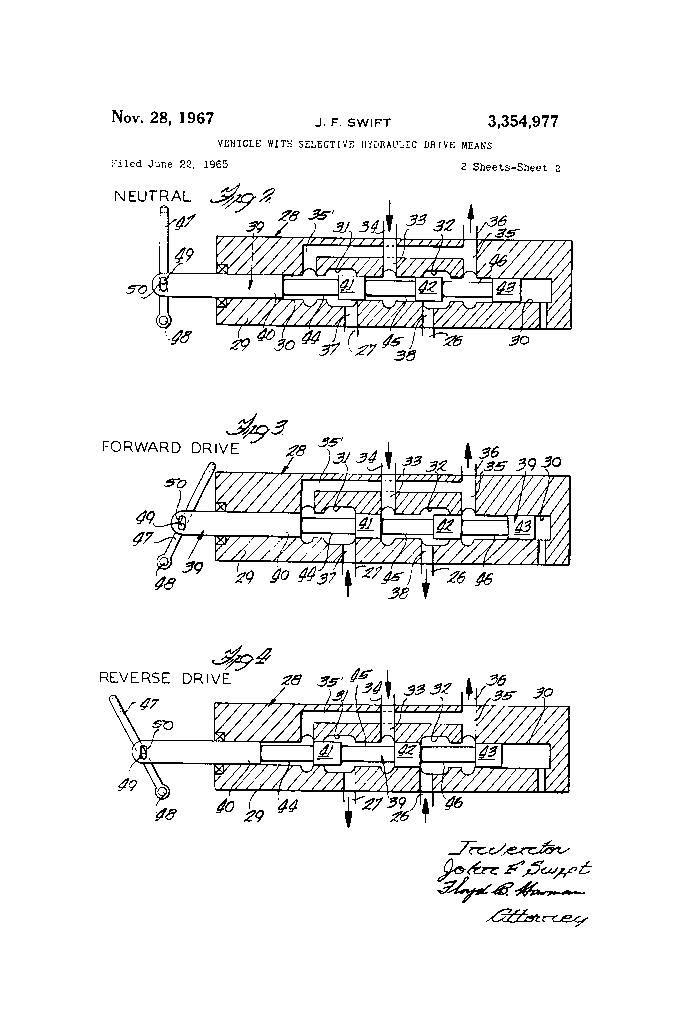
That’s a 1965 patent for a selective hydraulic drive — neutral, forward, reverse. It shows what nobody explains: neutral on a hydro isn’t gears sitting apart. It’s a valve position. The pump’s still turning, and “stopped” just means the flow has nowhere to go.
That Squeal Isn’t a Warning. It’s the Damage.
You shove the loader into a packed pile, the tractor quits moving, and something under the seat starts screaming. Everybody reads that as the machine asking you to back off.
It’s worse. That’s the relief valve opening, and behind it your pump is forcing oil at max pressure through a small orifice. The oil heats right there, fast — hot enough, and you get localized boiling, which scores the swash plate. That polite warning is the transmission grinding a groove in itself while your foot’s down.
Back off when you hear it. And read your manual on relief valves — as owners on TractorByNet have pointed out, some hydro tractors take a loader-specific one, and running a loader on the standard valve can damage the transmission and void the warranty.
Deere Just Moved Hydro Up a Weight Class
This stopped being a compact-tractor conversation in June, when John Deere put its first electronically controlled eHydro drive in a utility tractor — the 5E 3-cylinder, on the 5060E, 5067E and 5075E. Deere doesn’t build that hydro, incidentally; Danfoss supplies the pump and motor.
Owners have been split on hydro in heavy work for years. Farmers on Green Tractor Talk go around on it constantly — the loader crowd swears they’d never shift again, while one fellow pulling a subsoiler said his axle got too hot to touch and another put it plainly: he wouldn’t want a hydro doing field work. Deere just took that argument into 50-to-75 horsepower territory.
And on eHydro there’s no mechanical linkage between the pedals and the transmission — it’s sensors, and sensors age. One 3520 owner at 649 hours had no forward or reverse and no error codes. His dealer billed four and a half hours without finding it, corporate said split the tractor, and the quote came back eight thousand. Which is its own argument for owning a diagnostic scanner.
Don’t Reach for the Chain
Dead in the field is where folks finish off a transmission that was still saveable. Tow a hydro without the bypass open, and you’re running the system backwards — pump and motor become check valves, the oil has nowhere to go, and you build real pressure in a case designed for none. If the bypass lever is seized from sitting, don’t force it. Hit it with penetrating oil and work it gently.
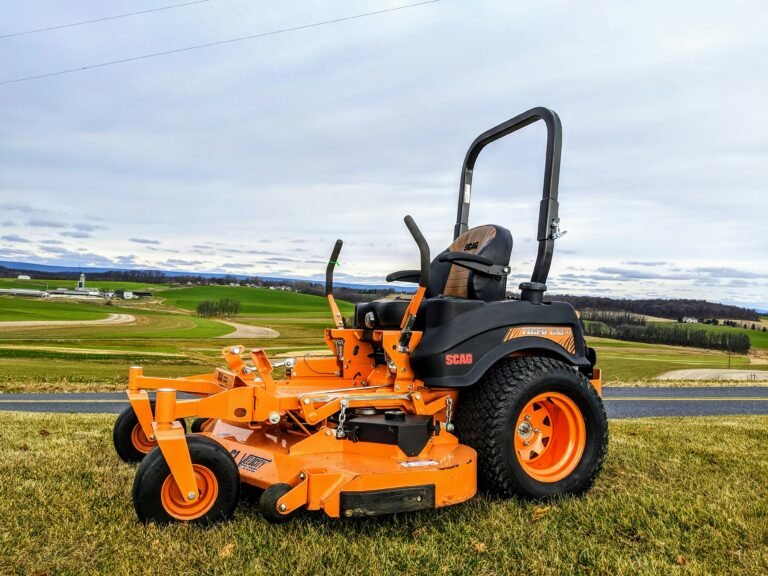
Here’s what separates your tractor from a mower: on a lot of compact tractors there’s no way to fully decouple the hydro from the rear pinion shaft. Deere’s 10 mph tow limit isn’t about the transmission at all — it’s the thrust washers and needle bearings ahead of that pinion, which only get lubricated when the system’s running. Tow it fast, and you cook bearings that had nothing to do with your original problem. Trailer it, or roll it slow in bypass, at a walk. Zero-turns are different again — the drive side is a sealed transaxle rather than a tractor transmission, which changes the whole diagnosis. We cover zero-turn mower problems separately.
What This Means For You
- Do the cheap work first. Fluid, filter, screen, correct spec fixes most of this for a fraction of a diagnostic visit.
- Get a pressure reading before anybody opens anything. Under 100 psi on the charge circuit is a charge pump conversation, not a transmission conversation.
- Treat heat as information. A hydro runs 10 to 15% less efficiently than a gearbox, and that lost power comes out as heat. Warm is normal. Too hot to touch after an hour on the loader is telling you something about load, fluid, or a plugged cooler screen — and it’s worth ruling out general overheating while you’re at it.
Most tractor hydrostatic transmission problems get quoted as a transmission before anybody’s put a gauge on the machine. Ask for the numbers.
FAQ
Why won’t my hydrostatic tractor move but the loader still works? Separate circuits — the loader and 3-point run off the implement pump, the hydro is its own loop. If the bucket is also weak, you’ve got a wider hydraulic problem. If it isn’t, that narrows it to linkage, the neutral safety switch, the charge pump, or the pump and motor. Check the bypass hasn’t been left open first — most common false alarm there is.
How much does it cost to fix a hydrostatic transmission on a compact tractor? Fluid and filter, about a hundred bucks. A charge pump, a few hundred to a couple thousand in parts, or $2,500 to $4,500 for full HST service at the dealer. Replacement runs $2,500 to $4,000 on a BX-sized machine, $4,500 to $7,200 on a bigger L. Which one you’re facing comes down to a twenty-minute pressure test.
Is a hydrostatic transmission bad for heavy field work? Depends what you’re doing. The man running the hydrostatics division at Danfoss told Power & Motion the technology belongs in machines doing a lot of back-and-forth, and that big horsepower tractors running long rows don’t use them — straight talk from somebody who profits selling them. Chores and loader work, hydro all day. Pulling ground for hours, a gearbox is still the honest call.
What’s your take on this? Drop it in the comments.