LS MT125 Problems: Why It Dies the Second It Moves
Some links here are affiliate links — if you buy through them, Dirt Road Mechanic earns a commission at no extra cost to you. It never affects which parts or tools we recommend. Full disclosure.
The LS MT125 problems that come up most often aren’t exotic: owners mostly report a tractor that won’t crank, dies the second it moves, or crawls along on a hydrostatic transmission that’s been starved of fluid. It’s a 24.7-hp sub-compact built around a Yanmar 3TNV80F three-cylinder and a two-range, two-pedal HST, and most of its documented trouble traces back to a handful of switches and one exposed filter. Knowing which ones can save a trailer ride to a dealer that, for some TractorByNet owners, is hundreds of miles away.
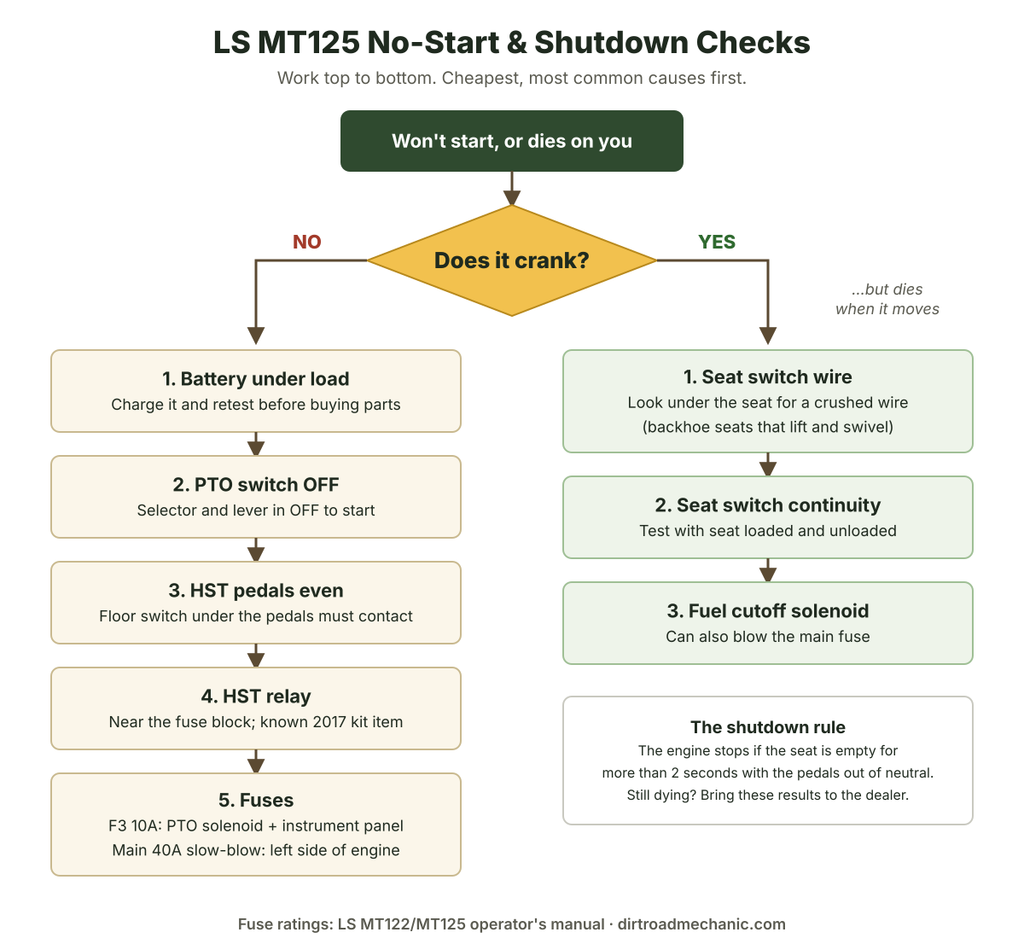
Why It Won’t Crank or Dies the Moment It Rolls
Per the MT122/MT125 operator’s manual, the MT125 won’t start unless someone is in the seat, the PTO switch is off, and both HST pedals are in neutral. Once running, it shuts down if the seat is empty for more than two seconds with the pedals out of neutral. That rule explains the most common complaint: a tractor that fires right up and dies as soon as it moves.
On backhoe machines, the seat lifts and swivels, and owners have repeatedly found the seat switch wire crushed underneath after the seat came back down. The documented fix is repairing the pinched wire, then tying it to a rod under the seat so it can’t fold into the pivot again. A continuity check across the switch, seat loaded and unloaded, tells you whether the switch or the wire is at fault; a Fluke 115 multimeter handles that and the circuit tracing below.
If the seat circuit tests good, look at the HST pedal switch under the floorboard. One TractorByNet reply points out that both pedals have to sit even for that switch to make contact.
The HST relay is the other usual suspect. One owner with about 300 hours replaced it after the tractor wouldn’t turn over, then found a bad fuel cutoff solenoid blowing the main fuse. For general starting-circuit testing, see tractor electrical problems.
The manual lists F3 as the 10-amp fuse for the PTO solenoid valve and instrument panel, and the main fuse is a 40-amp slow-blow on the left side of the engine. One 2021 MT125 kept blowing F3 at key-on until a technician found two alternator wires rubbing through on the engine block.
Don’t skip the battery. A 2026 thread listed a new starter and a key switch on order before the tractor started on a charger’s jump-start setting. A smart charger like the NOCO Genius 10 will tell you whether the battery is holding a charge before you start buying parts.
The HST Failure That Starts as a Fluid Leak
The transmission, hydraulic lift, and steering all draw from one reservoir. The manual lists 11.5 liters (3.0 gallons) on a bare tractor, 13.0 liters with a loader and 17.7 liters (4.7 gallons) with loader and backhoe, spec API GL-4, ISO VG 32/46. The factory backhoe has no separate tank, so a cut backhoe hose means the transmission is running low. (For the brand-wide fluid picture, see LS tractor problems.)
The expensive version of this is documented on TractorByNet. A previous owner hit the hydraulic filter, which had no guard, ran the tractor out of fluid, and kept driving it until it made very bad noises. A reply in that thread put just the HST portion at over $3,800 from a dealer with freight, and said the pump rotating group wasn’t available separately.
A sluggish MT125 isn’t always a dying HST. Owners have traced “slow” to a pedal linkage slipping where it meets the shaft into the hydro case, a wheel spinning inside the tire from a bad bead seal, and brakes that were partially applied. A range lever sitting between ranges also mimics a dead HST. More on that in hydrostatic transmission problems.
The manual’s troubleshooting table blames a no-move condition on low relief settings, a faulty charge valve, a clogged filter, or worn pump parts. Relief settings can’t be checked by feel; a hydraulic pressure test gauge kit gets you a real reading to bring to the dealer.
The hydraulic and HST filters are first changed at 50 hours, then every 250. The HST filter sits under the right-hand step, inside the main frame.
What the 2017 Tractors Got Fixed
The first MT125s got a set of small fixes LS sent to dealers, covered under warranty and usually done at the 50-hour service. Owners listed a smaller-headed oil drain plug (the original hit the axle), a replacement HST relay, and a bracket for the upper top link.
Early 2017 backhoe tractors also made the three-point arms a fight to install, sometimes requiring the rear tire to come off. LS’s update kit, which owners identify as part 20147916, cut that to a few minutes; late-2017 and 2018 tractors shipped with the revised design.
Service bulletin CS18-002 replaced a rubber-capped 3/8″ hose barb on the lower coolant drain with a pipe plug, because the cap could go brittle, crack, and leak. It applies by serial number to earlier tractors and isn’t a safety recall. For what LS has actually recalled, see LS tractor recalls.
The Mowing Argument
The mid-mount deck splits owners. One TractorByNet shopper said a dealer refused to sell him a mid-mower for it, expecting he’d be unhappy; another owner in that thread loves how his cuts. A 2025 thread on a 2017 MT125 describes a belly mower that quit despite a new solenoid, fluid check, and fresh filter, unresolved. If your deck stops, start with the PTO clutch circuit (see electric PTO clutch problems) and keep F3 in mind, since it feeds the PTO solenoid.
Checking Out a Used One
Ask the seller, or an LS dealer with the serial number, whether the 50-hour kit and CS18-002 were done. Lift the seat and look at the switch wire. Check the fluid level and color, and look for a guard over the hydraulic filter. Drive it uphill in both ranges.
On price, LS listed cash rebates of up to $4,000 on the MT125 for purchases through December 31, 2026, and one TractorByNet owner reported paying $17,500 out the door for a TLB with a mid-mower.
Most LS MT125 problems on record come down to switches, wiring, and fluid level rather than the Yanmar engine, which is good news for anyone handy with a meter.
FAQ
Who makes the engine in the MT125? Yanmar. It’s the 3TNV80F, a 1.3-liter three-cylinder Tier 4 diesel making 17.2 PTO hp.
How long is the warranty on an LS MT1 tractor? For tractors sold after January 1, 2017, the powertrain warranty runs six years or 1,500 hours, whichever comes first. Owners report two years of bumper-to-bumper coverage and one year on the loader and LS attachments.