Tractor Won’t Start in Cold Weather? The Way It Cranks Gives It Away
Some links here are affiliate links — if you buy through them, Dirt Road Mechanic earns a commission at no extra cost to you. It never affects which parts or tools we recommend. Full disclosure.
When a tractor won’t start in cold weather, the way it fails tells you more than a parts counter will. A slow crank, a fast crank that never catches, and an engine that fires and then dies each point to a different system. Winter Storm Fern in January 2026 drove wind chills to -55°F in Wisconsin, according to Drovers. NOAA’s October 2026 outlook leaned toward a milder northern winter under a strong El Niño, but a mild-leaning winter still brings cold mornings.
Slow Crank or No Crank: Battery, Cables, and Oil
Start here if the engine turns over slowly, or not at all. Cold takes a real bite out of a battery. Midtronics, which makes battery testers, puts a battery at about 80% of its capacity at 32°F and about 50% at 0°F.
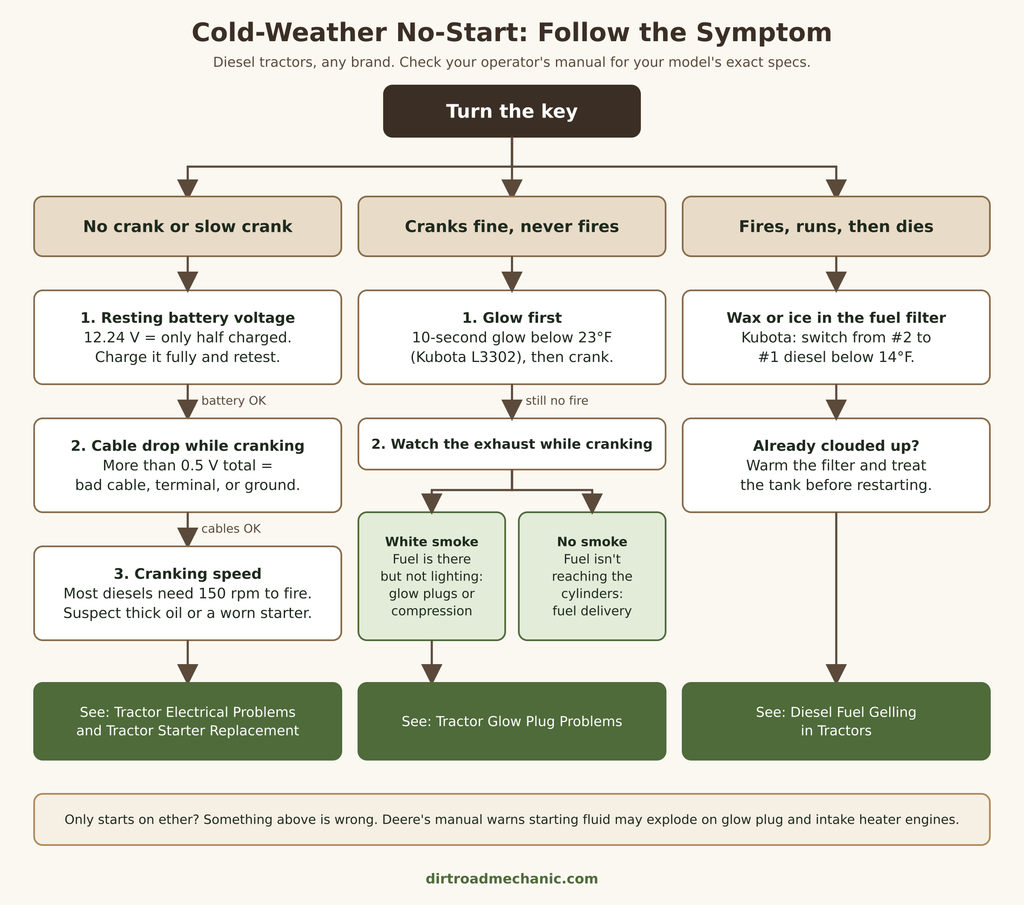
Put a meter on it before you buy anything. A Fluke 115 multimeter handles every electrical check in this section. Battery University gives 12.65 volts as fully charged and 12.24 volts as half charged, measured after the battery has rested off the charger. If yours reads near half, charge it fully with something like a NOCO Genius 10 and test again before you condemn it.
If the battery checks out but it still cranks slowly, the cables are next. With the meter across each cable end while someone cranks, Fluke’s guidance treats 0.2 to 0.5 volts of total drop as acceptable. More than that means the power is being lost in a cable, a terminal, or a ground. On TractorByNet, an owner of a John Deere 310SE backhoe said it would hardly turn over below 35°F even though the batteries tested nearly full. The advice he got was to run a heavy ground strap from a starter bolt to the battery negative and move grounds off sheet metal and onto the block. The electrical problems guide covers tracing a bad ground.
Speed matters as much as amps. Mitchell 1’s diagnostic guidance says most diesel engines need at least 150 rpm of cranking speed to fire. Anything that slows the engine down can keep a healthy diesel from catching: a worn starter, oil that’s too thick, or hydraulic drag. Oil is the part owners overlook most. Kubota’s oil chart calls for 10W-30 below 32°F, and your own manual’s temperature chart, not the oil you ran all summer, decides what goes in for winter.
If you get nothing at all, not even a click, check the interlocks before the starter. The Kubota L3302 operator’s manual won’t let the engine crank unless the PTO is off and the speed control lever is in neutral.
Cranks Fine but Never Catches
A strong crank with no fire usually means the cylinders aren’t getting hot enough to light the fuel. The Kubota L3302 manual says to hold the key at the glow position for 10 seconds when it’s below 23°F, crank no more than 10 seconds, then wait 30 seconds before the next try. Owners starting machines well below zero on TractorByNet often run a full glow, release, and glow again before cranking.
Watch the exhaust while it cranks. Forum members point out that white smoke means fuel is reaching the cylinders but not igniting, which points to glow plugs or low compression. No smoke at all points back to fuel delivery. The glow plug guide walks through testing the plugs, relay, and timer with a meter.
Fires, Runs a Minute, Then Quits
This one is almost always fuel. A Kubota BX2670 owner in northern Michigan described it on TractorByNet: the tractor started, ran anywhere from 30 seconds to a couple of minutes, then stalled every time the temperature got down to about 15°F. Replies pointed to wax or ice blocking the filter.
Kubota’s guidance is to switch from #2 to #1 diesel below 14°F. If the fuel has already clouded up, warm the filter and treat the tank with Power Service Diesel 9-1-1 to get it running again. The fuel gelling guide has the full thaw-out procedure and blending ratios.
When It Only Starts on Ether
A tractor that needs a shot of starting fluid every morning is telling you something else is wrong. Ether hides the problem; it doesn’t fix it. A recurring line on TractorByNet: “If you start using starting fluid, you will always need starting fluid.”
It can also be dangerous. John Deere’s PowerTech 4045 operator’s manual says not to use starting fluid on engines with glow plugs or air intake heaters, because it may explode. The same manual calls for starting aids below 32°F, meaning a block heater or the engine’s own preheat system, not a can of ether.
One TractorByNet thread shows how ether covers a real fault. A Kubota TC33D owner could only start it cold with ether, even though his glow plugs tested fine. Another member had the same symptom from a worn starter that dragged and cranked too slowly. Replacing the starter fixed it. If your cranking speed sounds lazy, the starter replacement guide covers what to check.
Tier 4 Machines and the Dealer-Only Problem
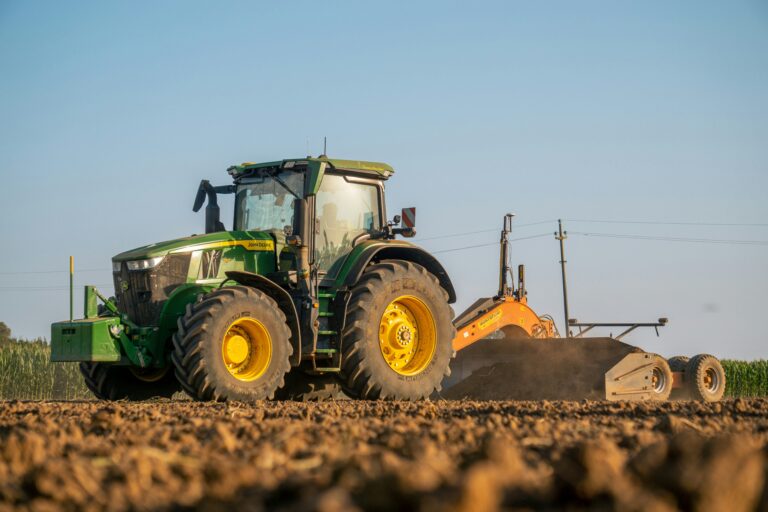
Newer emissions-equipped tractors add one more way to be stuck: an engine that runs but sits in reduced power or limp mode and won’t clear without dealer software. On July 8, 2026, the FTC and five states announced a settlement requiring John Deere to give farmers and independent shops the same tools dealers get. That includes reading and clearing fault codes and restarting a machine after an emissions-related limp mode shutdown. The order runs for 10 years. Other brands aren’t covered by that order. Deere owners can find brand-specific checks in the John Deere won’t start guide, and Kubota owners in the Kubota won’t start guide.
Before You Call for a Tow
Work it in this order: battery voltage, cable drop, cranking speed, glow time, then fuel. Ether goes at the bottom of the list, if it’s on the list at all. Most times a tractor won’t start in cold weather, the answer turns out to be a charger, a cable, or the right fuel, not a tow. After that, a block heater on a timer keeps it from happening again.
Quick Questions
Is it ever too cold to start a diesel tractor? Not if it’s prepared. Deere’s PowerTech manual calls for starting aids below 32°F and additional aids below -22°F. Owners on TractorByNet report starting tractors stored outside at -22°F with a block heater and a battery kept on a maintainer. If the battery itself is the weak link, see the tractor battery guide.
How long should you crank a cold diesel? Kubota’s L3302 manual says no more than 10 seconds at a time, with a 30-second rest between attempts.