The Most Reliable Tractor Brands in 2026: What Really Keeps a Machine Running
Some links here are affiliate links — if you buy through them, Dirt Road Mechanic earns a commission at no extra cost to you. It never affects which parts or tools we recommend. Full disclosure.
Ask ten farmers to name the most reliable tractor brands, and you’ll get ten confident, half-contradicting answers. Here’s the thing nobody says out loud: there’s no real reliability data for farm tractors. Consumer Reports scores riding lawn mowers, not the machine hauling your bush hog. The ranking everybody quotes is a consumer trust survey — a popularity contest John Deere has won seven years running — and most of the “top 10” lists rank brands by units sold, which tells you nothing about what breaks at hour 1,800. So let’s throw that out and talk about what actually matters when you’re standing in a field with a machine that won’t move.
Reliability isn’t what breaks least — it’s what you can keep running.
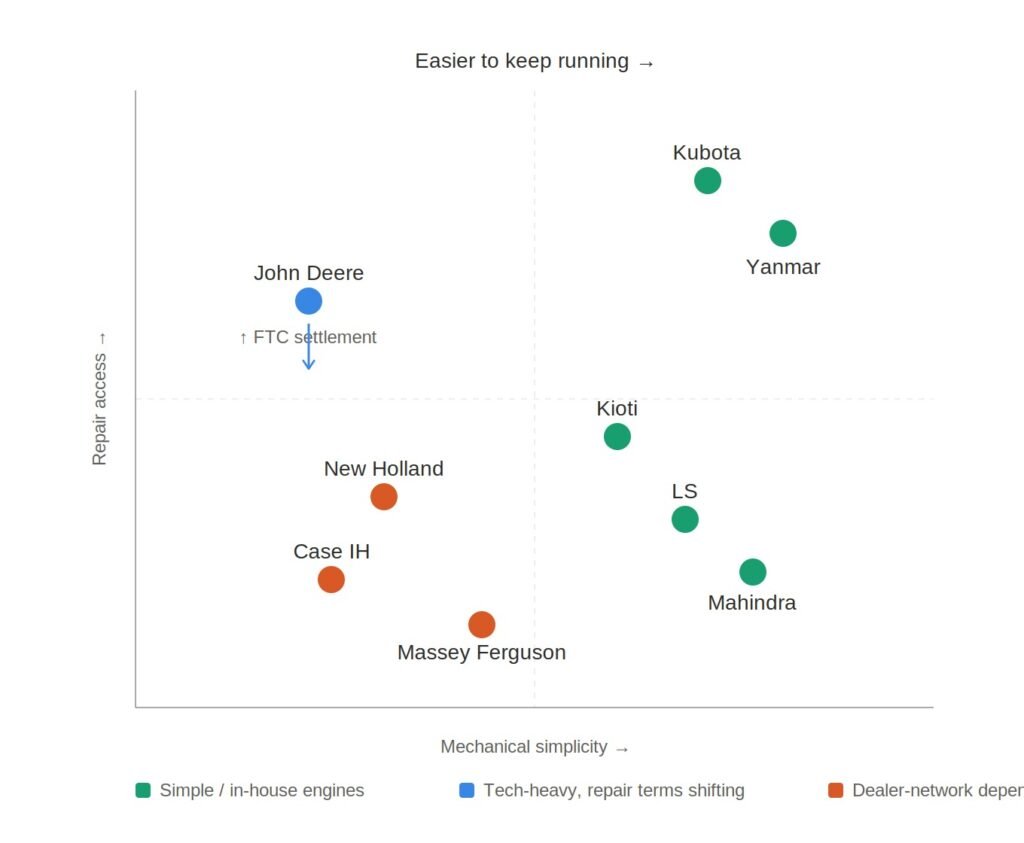
Here’s the reframe that changes everything. A tractor’s real-world reliability isn’t just how often it fails — it’s whether you can fix it when it does. How simple the machine is, whether parts show up fast, how far the dealer is, and whether you’re even allowed to work on it yourself. A bulletproof machine you can’t get parts for mid-haying is less reliable, in every way that counts, than a simpler one with a dealer six miles down the road.
That’s not just my opinion. Read any of the long-running “rank the brands” threads on TractorByNet and the guys with real hours keep landing in the same spot: Kubota and Deere up top, sure, but plenty will tell you Kioti and LS are every bit as reliable — and the tiebreaker is almost always dealer distance. One older fella laid it out perfectly: his Kubota dealer is six miles away,y and the nearest LS is eighty, so at his age, local support won before the machines even got compared. That’s the whole ballgame.
The right-to-repair bombshell that just reshuffled the deck
If you only heard one piece of tractor news this year, this should be it. On July 8, 2026, John Deere settled the FTC’s right-to-repair lawsuit. For the next ten years, under FTC supervision, Deere has to give farmers and independent shops the same diagnostic software and repair tools it hands its own dealers. That’s the second settlement this year — back in April they put $99 million into a fund for farmers who’d been forced to pay dealer rates since 2018.
Why does this matter for a reliability conversation? Because Deere’s biggest knock was never the iron — those machines are tough. It was that when the computer threw a code, you were hostage to the dealer and their ADVISOR tool, sometimes hours away, right when the clock mattered most. That’s a reliability problem even if the tractor itself never fails — the same way a hydrostatic transmission that’s expensive to diagnose can strand you regardless of build quality. The settlement doesn’t erase years of frustration overnight, and the reaction has been measured — repair advocates called it “cautious optimism,” and one industry columnist framed it as “a new chapter, not the end of the story.” But it genuinely moves Deere up on the one axis where it always lagged. If you’ve been avoiding green over repair-lockout worries, it’s worth a fresh look.
Why timing makes this the wrong year to guess wrong
Everybody’s holding onto equipment longer, and that’s not by accident. Tariffs have hammered the whole industry — Deere alone is staring down a $1.2 billion hit in fiscal 2026, roughly double last year, and nearly every dealer is forecasting price increases. New iron got expensive, financing got worse, and Deere’s own CEO called 2026 the bottom of the ag cycle. So people are keeping tractors fifteen, twenty years and buying used. The question isn’t “what’s shiny on the lot” — it’s “which brand is still running when my grandkid takes it over.” One quiet tell: when dealers were surveyed on 2026 sales, Kubota’s were the only major-brand group forecasting growth.
Where each brand actually lands
Kubota earns its reputation the honest way — builds its own engines, keeps the machines simple, and holds 45–50% of the 18-to-70 horsepower market against Deere’s roughly 20%. That dominance with very few horror stories tells you plenty. Not flawless — it recalled about 2,600 MX5400DTC utility tractors in early 2025 over a clutch cable that could cut braking power, and ate a record $2 million FTC fine for “Made in USA” parts that weren’t. But for keeping-it-running simplicity, orange is hard to beat. (Our Kubota problems guide and Kubota maintenance schedule have the model-specific stuff.)
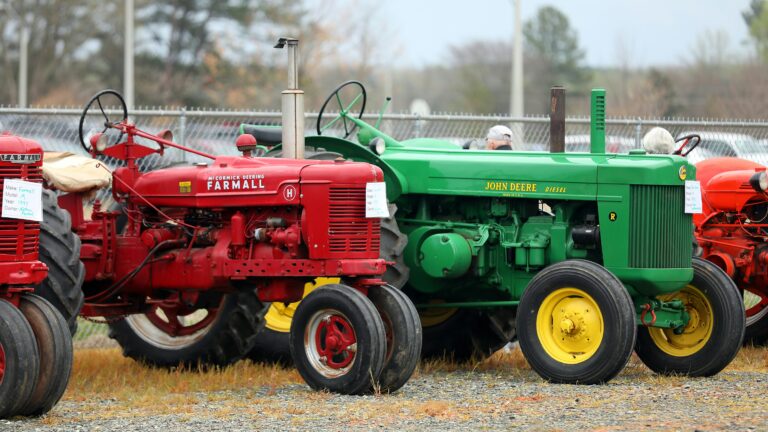
John Deere builds excellent iron with the deepest dealer network and best resale in the business — the “green tax” is real, and so is the loyalty. Repair access was the asterisk, and the FTC settlement is erasing it. Worth knowing: a lot of Deere’s compacts over the years were Yanmar-built or Yanmar-powered, part of why those little green machines have such a bombproof reputation.
Yanmar backs its machines with a 10-year warranty — a serious statement — though the thin dealer network is the tradeoff. (More in our Yanmar problems guide.)
Kioti and LS, the Korean brands, are the value story. Kioti (built by Daedong) makes its own Tier 4 engines in-house and is chasing 15% market share, and forum owners rate both as reliable as the big two. Dealer density is the main caveat — check how far away support is before you sign. (See our Kioti and LS problems guides.)
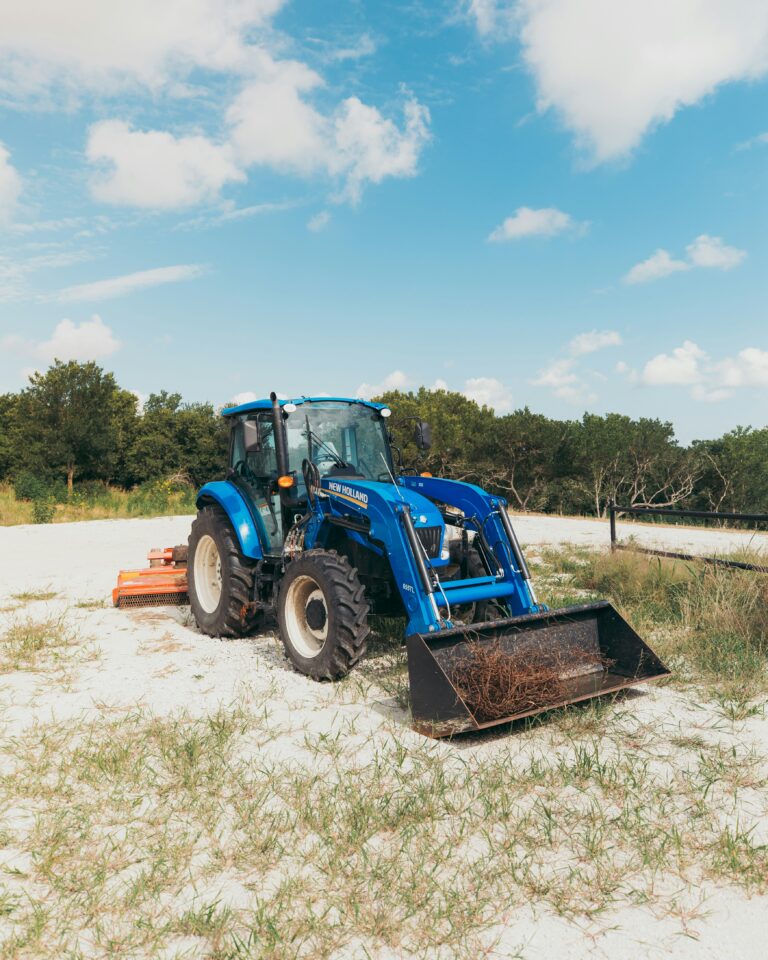
New Holland, Case IH, and Massey Ferguson make capable tractors, but effective reliability leans hard on your local dealer and parts pipeline. For brand-specific failure points, see our separate guides on Case IH, New Holland, and Massey Ferguson problems.
What this means for you
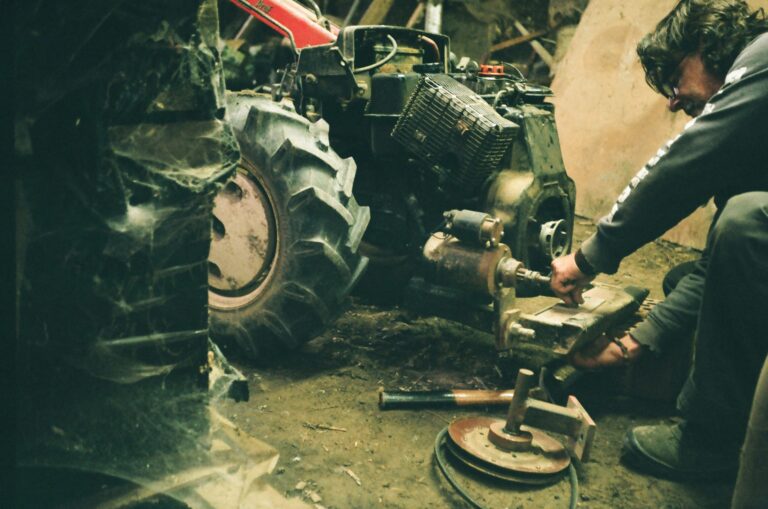
Stop shopping for the badge and start shopping for the whole picture. Before you buy, drive to the nearest dealer for that brand and clock the distance — then imagine making that drive twice in a week during planting. Ask what a common repair costs and how fast parts show up. Favor mechanical simplicity if you plan to turn your own wrenches, because the simpler the machine, the more of it you can handle in your own shop. And whatever color you land on, protect it by using the right hydraulic fluid — the correct Kubota Super UDT2 or John Deere Hy-Gard isn’t where you cut corners, since a wrong-fluid hydraulic job costs more than the tractor ever saved you.
The most reliable tractor brands, in the end, are the ones that fit your situation — your acreage, your dealer, your willingness to wrench. Buy the machine you can keep running, not the one that wins the internet argument.
FAQ
What is the most reliable tractor brand? There’s no single answer backed by hard data, but Kubota consistently ranks at or near the top for mechanical simplicity and DIY serviceability, with John Deere right there on build quality and dealer support. The “best” one is whichever combines a machine you trust with a dealer close enough to actually help you.
Are Kubota tractors more reliable than John Deere? Owners generally give Kubota the edge on simplicity, price, and fixing it yourself, while Deere wins on dealer network, resale value, and — now that the FTC settlement is in place — much-improved repair access. Neither is a bad choice; they just suit different buyers.
Which tractor brand breaks down the least? Nobody tracks failure rates across brands, so anyone claiming a hard number is guessing. What owners report is that simpler machines with strong local parts support keep them running longest — which is why Kubota and Deere compacts with Yanmar engines get named so often.
What’s your take on this? Drop it in the comments.