Tractor Tire Chains: Why the Wrong Set Spins, Rubs, or Wrecks Your Driveway
Some links here are affiliate links — if you buy through them, Dirt Road Mechanic earns a commission at no extra cost to you. It never affects which parts or tools we recommend. Full disclosure.
Buying tractor tire chains isn’t like grabbing a set for the pickup. The tread on your tires, the gap under your fenders, and what surface you drive on all decide which chain works. Get one of those wrong, and you end up with chains that spin uselessly, rub a fender, or chew up a driveway. Owners on TractorByNet are blunt about the payoff, though: on ice and packed snow, R4 industrial tires are close to useless without them.
Your Tread Pattern Picks the Chain
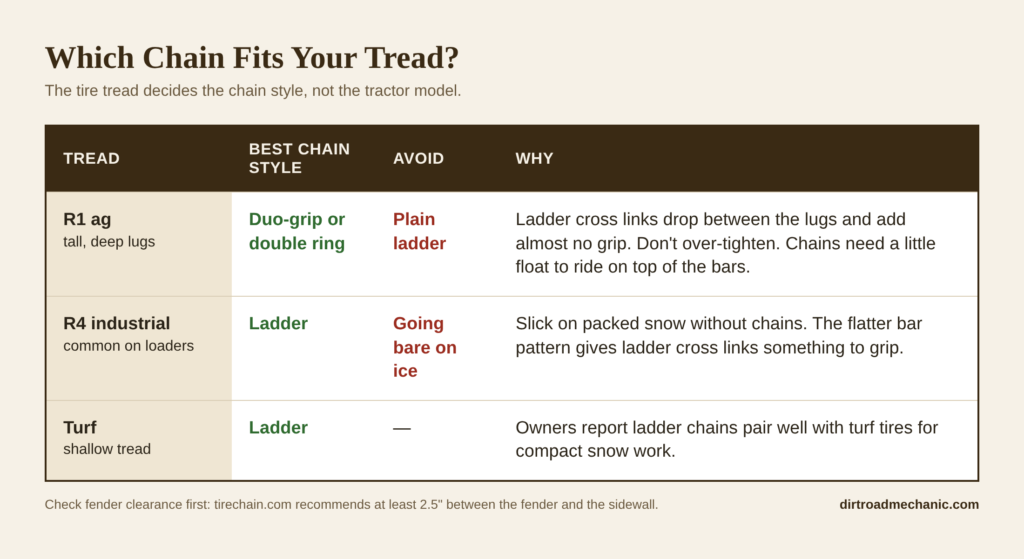
R1 ag tires have tall, deep lugs. Plain ladder chains tend to drop into the gaps between those lugs, where they add almost no traction. Duo-grip or double ring chains are the better match, because the extra side chains keep the cross links riding on top of the bars. One more point that surprises people: owners warn against cranking chains drum-tight on ag tires. They need a little float to stay up on the lugs. Pull them too tight, and they settle down between the bars.
R4 industrial tires are what most loader tractors wear, and they’re slick on packed snow. One TractorByNet owner reported he had to run 4WD just to push six inches of snow with a 5,300-pound tractor on bare R4s. The flatter bar pattern does give ladder chains something to grip, so plain ladder chains work well here.
Turf tires pair well with ladder chains too.
Cross-link spacing matters as much as the pattern. A “2-link” chain has a cross chain every second link along the side chain, while a “4-link” spaces them farther apart. A Ford 1210 owner working on steep ground reported he needed the tighter 2-link spacing, not the 4-link he started with.
Measure the Fender Gap Before You Order
Tirechain.com recommends at least 2.5 inches between the fender and the tire sidewall. On an average hand, that’s about three fingers. If you can’t fit three fingers, you have a few options:
- Reverse or swap the wheels. On R4s, owners report gaining roughly 1 to 1.5 inches by flipping the rims.
- Add wheel spacers. A Kubota B3030 owner on TractorByNet reported paying about $300 installed. He had the dealer do it because his tires were loaded.
- Check the cab before you assume anything. One owner reported his John Deere dealer said many cabbed compact models shouldn’t run rear chains at all because of clearance.
Size chains by the numbers on the sidewall, not by the tractor model. Even then, owners regularly report needing extension links or extra cross links to get a proper fit. Test-fit before you cut anything.
Front Chains on a 4WD: Where Owners Split
This is the most argued question about chains, and the disagreement comes from how MFWD axles are built. Most front-wheel-assist axles are geared to turn slightly faster than the rears. That lead helps the front pull the tractor through a turn, but it also means the front tires need to slip a little. On loose snow, they slip easily. Chain them up on a high-traction surface, and that slip turns into windup in the front driveline. That’s the reason many dealers and owners say to chain the rears only.
The other side has a fair point. An owner who chains all four every winter argues the overdrive issue only really matters on hard-packed, high-traction surfaces like pavement. John Deere also sells a front spacer built specifically for chains. Part number LVU12475 is listed for the 2×20 series, such as the 2520 and 2720. Without it, even a light chain can hit the tie-rod ends. One owner reported it takes longer: 14 mm × 50 mm bolts, part number LVU13274.
Plenty of people find rear chains are enough. An L3710 owner bought front and rear sets years ago, and the fronts are still in their boxes. Read your operator’s manual first, because manuals don’t agree from model to model. If you do run front chains, keep them to snow and ice, not dry pavement with the front axle engaged.
Chains on Concrete and Asphalt
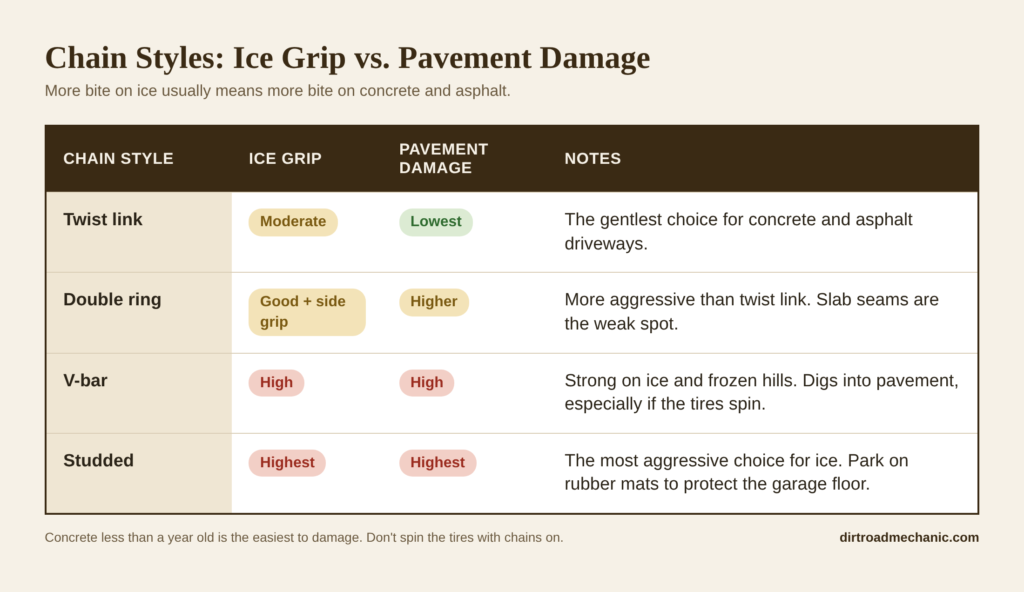
Not every chain is hard on pavement, and the style makes most of the difference:
- Twist-link chains are the gentlest on concrete and asphalt.
- Studded and V-bar chains bite hardest on ice, and they will dig into pavement too, especially if the tires spin.
- Double ring chains are more aggressive than twist link, and seams in a slab are the most vulnerable spots.
- New concrete is the soft target. Owners widely warn that a slab under a year old is easy to damage by spinning chained tires.
Many owners park on rubber horse stall mats in the garage, so studded chains never touch the floor.
Getting Them On Tight and Keeping Them There
The easiest installation method on the forums goes like this:
- Stretch each chain out flat behind its tire, with no twists and the hooks facing up.
- Back the tractor onto them until the axle sits over the last cross link.
- Drive forward slowly. The tire pulls the chain up and over, leaving the loose ends at a comfortable working height.
Fasten the inside first, then the outside. Drive a short distance, stop, and tighten again, because chains settle. If they don’t fit perfectly, add tensioners. Aquiline’s installation sheet also says not to spin the tires or accelerate hard with chains on. Don’t count on zip ties. One owner’s zip ties let go on the inside, and the chain caught on the axle and rear fender mount. Another owner’s chain flipped off and wrapped around the axle on the way to clear snow.
For the rest of the cold-weather list, see the tractor winterizing guide. If chains on the front leave the steering heavy or vague, the steering problems breakdown covers what to check.
Quick Answers
My rear tires are loaded. Do I still need chains? Usually, yes. Ballast adds weight, but rubber on ice is still rubber on ice. A Kubota B2650 owner on OrangeTractorTalks reported sliding all over the place in snow even with loaded tires.
Can I use truck chains on a small tractor? Sometimes. Owners report running light-truck or ATV/UTV chains on compact tractors when the tire size lines up, often for less money than tractor-specific chains. Match by diameter and width, and check that the cross links clear the lugs.
The order that works: read the sidewall size, measure the fender gap, decide what surface you’ll drive on most, and only then shop for tractor tire chains.