Yanmar Tractor Problems: How to Spot Them Before They Cost You
Some links here are affiliate links — if you buy through them, Dirt Road Mechanic earns a commission at no extra cost to you. It never affects which parts or tools we recommend. Full disclosure.
Yanmar tractor problems don’t get talked about nearly as much as Kubota’s or John Deere’s, and that’s partly because the biggest issues with these machines aren’t really mechanical — they’re about what happens after you own one. Tariffs are shaking up pricing on every Japan-built tractor right now, and if you’re running an older or gray-market Yanmar, the code stamped on your engine block might matter more than anything else under the hood. Here’s what’s actually going on with Yanmar right now, and what it means whether you’re buying, selling, or just trying to keep one running.
An Engine Company That Happens to Build Tractors
Most people don’t realize Yanmar was building diesel engines for decades before it ever built a full tractor — the company dates back to 1912, and its agricultural equipment division didn’t even start until 1961. What’s more relevant to anyone shopping green or orange iron: according to TractorData’s Yanmar history, Yanmar actually built utility tractor models for John Deere in the early 1980s under a direct manufacturing arrangement, and it’s still an engine supplier to Deere’s utility line today. Kubota, Case IH, and the rest build the whole machine in-house, top to bottom. Yanmar’s reputation was built as the engine guy first — the tractor came second.
The Real Yanmar Tractor Problem Is Parts, Not the Engine
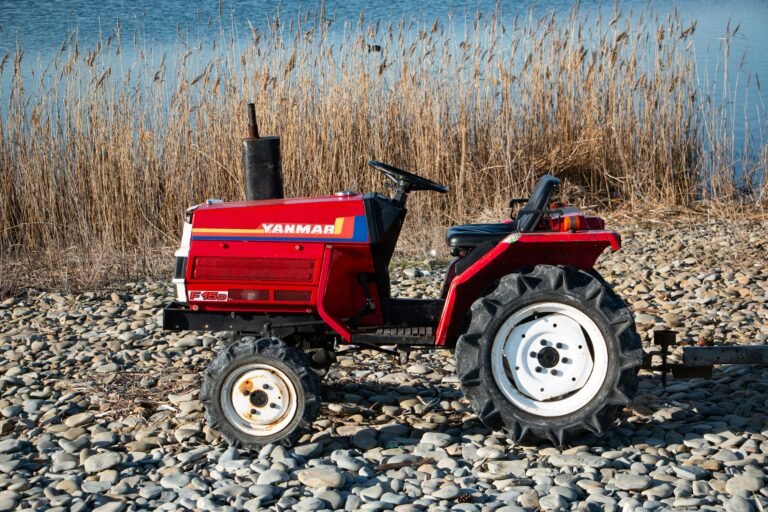
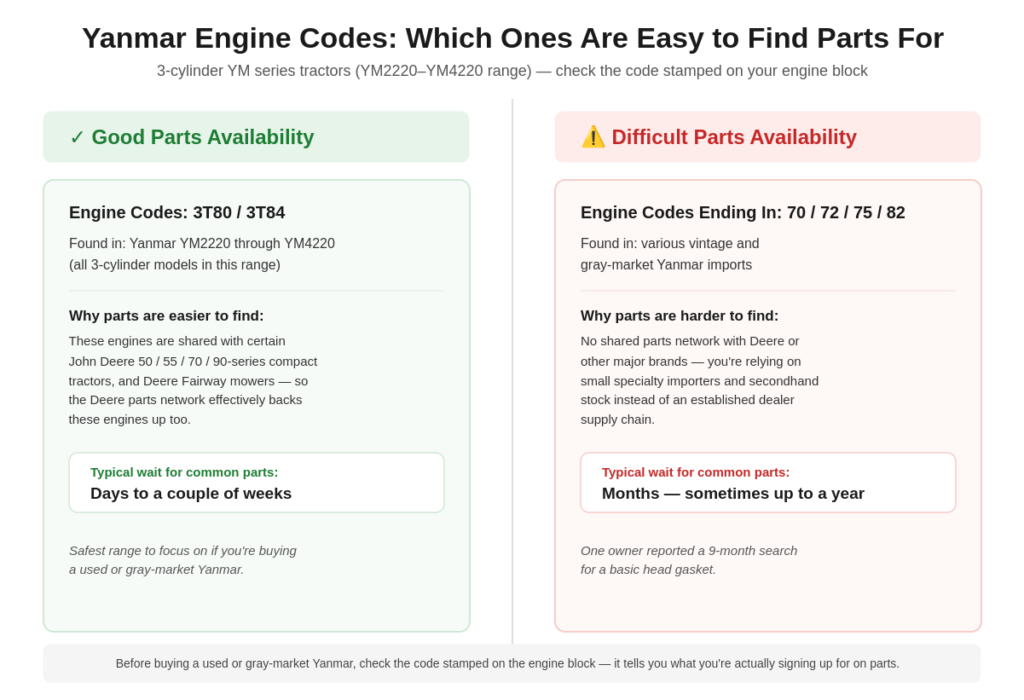
Talk to anyone who’s owned one of these for a while, and the complaint rarely lands on the engine itself. It lands on finding parts for it. If you’ve got a 3-cylinder YM model somewhere in the YM2220 to YM4220 range, check the engine code before you panic about anything else. The 3T80 and 3T84 codes are your friend — they’re shared with certain John Deere 50, 55, 70, and 90-series compact tractors and Deere’s Fairway mowers, so the Deere parts network backs you up whether you meant for it to or not. Codes ending in 70, 72, 75, or 82 are a different story. Owners on the gray-market forums report waiting months for parts that should be simple — one guy spent nine months chasing down a basic head gasket.
The Most Common Yanmar Tractor Problem You Can Actually Fix Yourself: A No-Start
Here’s where Yanmar’s “engine company first” identity actually works in your favor. Most Yanmar compact and utility diesels are simple mechanical engines — no computer, no electronic throttle body throwing a code you’d need a diagnostic scanner to read — which means a no-start is usually something you can run down yourself in the driveway instead of hauling it to a dealer.
Start with the air intake before you touch anything else. Pull the filter housing and look inside — it’s not unusual for mice to nest in there over the off-season, and a blocked filter will choke off airflow completely. Check the muffler next: the internal baffles on older units can rust out and collapse, which blocks exhaust flow just as effectively as a clogged intake and will keep the engine from firing even with a strong battery and a good starter.
If the tractor’s been sitting for a season, crack the fuel line fitting at the injector, crank the engine until fuel runs out clear with no air bubbles, then snug the fitting back down. Trapped air in the line is one of the most common fuel system problems behind a Yanmar diesel that cranks and cranks but never catches. On cold mornings, give the glow plugs their full cycle instead of cutting it short. If you’ve checked all of that and it still won’t fire, a compression test is the next real step — Yanmar diesels generally want to see figures in the 400-600 psi range, and a weak reading points you toward the head gasket or rings instead of wasting a weekend guessing at the fuel system.
Gray Market Yanmars and the Cub Cadet Chapter Nobody Remembers
A real chunk of the Yanmars running around the US were never sold new here at all — they came in secondhand off Japan’s domestic market through independent importers, which is a story none of the other tractor brands on this site really have. Even Yanmar’s official US presence has a wrinkle: from 2006 to 2011, its compact tractors were sold jointly with MTD under the Cub Cadet Yanmar name before Yanmar America took the whole lineup over solo. All of that history is part of why Yanmar still has weaker brand recognition — and softer resale value — than Kubota or Deere here, even though the machines themselves hold up fine.
The Warranty and Reliability Numbers Are Real
This is where Yanmar actually has a case to make. New tractors come with a 2-year bumper-to-bumper warranty plus a 10-year or 3,000-hour powertrain warranty covering the engine, front axle, transmission, and final drive — most competitors top out around 6 years, per Yanmar’s dealer-published warranty terms. Yanmar has also claimed the #1 spot in an Equipment Dealers Association product-quality survey for multiple years running (worth noting that’s a dealer-published ranking, not an independent lab test, but it lines up with what owners say). In a MyTractorForum thread, one shopper cross-shopping a YM342 against a Massey Ferguson 1840 and a Mahindra 1640 pointed out it’s fully mechanical with no touchscreen or electronic nannies to fail later — plus that warranty nobody else matches.
Tariffs Are the Next Yanmar Tractor Problem to Watch
Since Yanmar tractors are Japan-sourced, the current US-Japan trade framework hits them directly. The deal locked in a 15% tariff rate instead of a threatened 25%, and it’s reviewed quarterly, so nothing here is settled for good. Kubota — facing the same exposure — has already raised North American prices twice to cover the difference, with more increases planned. Farmers on TractorByNet were digging into exactly this in a thread titled “Japan Ag machine makers win on tariffs” back in June, and the takeaway most people landed on is that today’s price is probably the cheapest one you’ll see for a while.
What This Means For You
Bottom line on Yanmar tractor problems: they’re rarely about the machine itself. If you’re eyeing a used or gray-market Yanmar, find the engine code before you find the price — it tells you more about your ownership experience than the hour meter does. If you’re buying new, the warranty math genuinely favors Yanmar over brands that cap out at 6 years, and a dealer-sold machine sidesteps the whole parts-scavenging problem entirely. Either way, keep a bottle of PB Blaster on hand for freeing up anything that’s been sitting, and if your model calls for something OEM-specific that’s out of stock — the same headache we’ve covered for John Deere hydraulic fluid — TRIAX Agra UTTO XL is a solid universal hydraulic/transmission fluid to have as a backup rather than parking the tractor while you wait on a special order.
FAQ
Are Yanmar tractors reliable? Yes — Yanmar has topped dealer-published quality surveys multiple years running, and its 10-year/3,000-hour powertrain warranty is longer than what most competing brands offer.
Why is it hard to find parts for old Yanmar tractors? It depends on the engine code. Some codes share parts with certain John Deere models, but others — common on gray-market imports — have no shared dealer network, so parts can take months to track down.
Does Yanmar still make engines for John Deere? Yes. Yanmar built utility tractor models for Deere in the early 1980s and remains an engine supplier for parts of Deere’s utility tractor lineup today.
What’s your take on this? Drop it in the comments.