
Hydraulic Fluid Substitute: What a Federal Lawsuit Just Proved About “303”
Some links here are affiliate links — if you buy through them, Dirt Road Mechanic earns a commission at no extra cost to you. It never affects which parts or tools we recommend. Full disclosure.
A hydraulic fluid substitute has to satisfy three jobs at once on most compact tractors: lubricating the wet brakes, driving the PTO clutch, and running the loader or three-point hitch, all from one shared reservoir. Get the substitute wrong, and it rarely fails right away — it shows up eighteen months later as a chattering brake or a hydrostatic transmission headed for a rebuild. And there’s now a federal court record confirming that at least one widely sold “universal” option never met the specification it claimed to.
The Spec Is What Matters, Not the Brand on the Jug
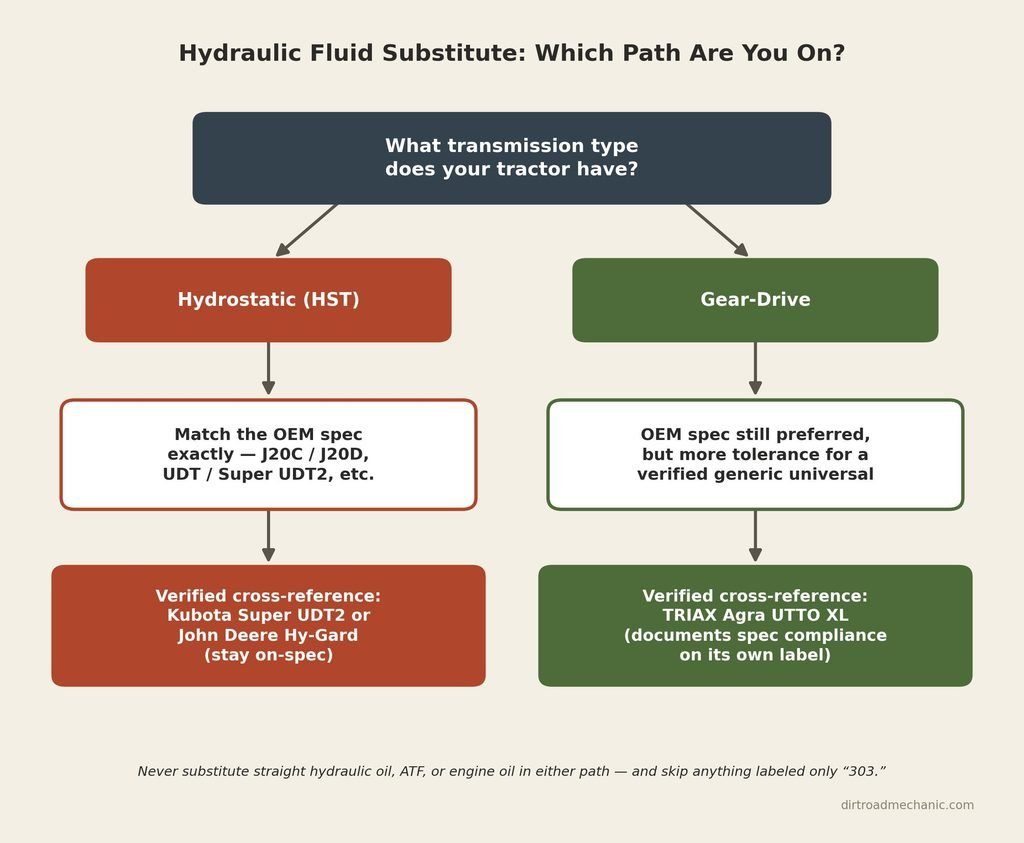
Every OEM fluid is really a performance specification wearing a brand name. John Deere’s own current spec sheet lists Hy-Gard as meeting JDM J20C, with an ISO viscosity between 46 and 68, while Low-Viscosity Hy-Gard meets J20D at ISO 32 for cold starts. Kubota’s line splits the same way: standard UDT is a conventional mineral-oil formula, while Super UDT2 is a full synthetic with a viscosity index of 199 and roughly 0.11% zinc by weight for anti-wear protection — and Kubota’s own spec documentation confirms Super UDT2 is fully backward compatible with the older UDT and Super UDT it replaced. (If you’re not sure whether your machine even runs one shared fluid or two separate ones, that’s worth settling before anything else — we cover the distinction in our transmission fluid vs. hydraulic fluid breakdown.) The rule that actually holds up here: a genuine substitute has to print the target spec on its own label — “meets J20C,” “UDT2 compatible” — not just the word “universal.”
Case and New Holland run their own separate family entirely — MS-1207 and Hy-Tran Plus for older equipment, MS-1210/TCH for newer machines — and Massey Ferguson has its own line under M-1110, M-1127, M-1135, and M-1141 (branded Permatran III). Neither gets nearly the online coverage that Deere and Kubota do, which is part of why so many Case and MF owners end up guessing instead of checking a spec sheet.
What Actually Happened With “303”
For years, “303” was the default answer to “what else can I run in this?” That’s no longer defensible. Missouri’s Department of Agriculture tested 14 different fluids sold under a “303” label and found all 14 failed to meet any current specification — the department’s own alert notes that the John Deere 303 designation is 57 years old and has been obsolete for more than four decades. That finding fed into a multidistrict lawsuit against Smitty’s Supply and CAM2 International, and in the spring of 2025 a federal judge finalized a $31.9 million settlement with those manufacturers, on top of an earlier $7.2 million settlement with the retailers — Tractor Supply, Rural King, Orscheln, and Atwood — who sold the products. O’Reilly settled a separate suit over its own house-brand 303 fluid. None of that means every generic fluid is suspect. It means “303” specifically is a name without a spec behind it, and a fluid that only claims “303” compatibility isn’t proving anything.
Matching Fluid to Machine
| Brand | OEM Spec | Example Cross-Reference |
|---|---|---|
| John Deere | J20C (standard), J20D (low-viscosity) | Hy-Gard, TRIAX Agra UTTO XL |
| Kubota | UDT, Super UDT, Super UDT2 | Kubota Super UDT2, TRIAX Agra UTTO XL |
| Case / New Holland | MS-1207 / Hy-Tran Plus | Akcela Hy-Tran Ultra |
| Massey Ferguson | M-1135, M-1141 (Permatran III) | TRIAX Agra UTTO XL |
TRIAX’s Agra UTTO XL is one of the few aftermarket products that documents compatibility across all of the above on its own spec sheet — it lists John Deere J20C, Kubota UDT2 and Super UDT, and Case MAT 3525 UTTO by name, which is the kind of specific, checkable claim that separates a real cross-reference from a bottle that just says “universal” and hopes nobody asks. If you’re staying with Kubota’s own fluid rather than substituting, our full breakdown of Kubota’s UDT2 spec covers capacity and OEM part numbers.
Where Owners Actually Draw the Line
The risk tolerance isn’t uniform, and a March 2026 TractorByNet thread on the subject makes that split obvious. Owners running hydrostatic transmissions were firm about staying on OEM-spec Super UDT2, reasoning that with a hydro repair running into the thousands, saving a few dollars a gallon isn’t worth the gamble. Owners with straight gear-drive transmissions were noticeably more relaxed, with several reporting years of trouble-free use on store-brand universal fluid. That distinction — hydrostatic versus gear-drive — is doing more real work in that conversation than brand loyalty is. The same logic applies on the John Deere side, where our Hy-Gard breakdown covers the same J20C-versus-J20D question for Deere-specific machines.
There’s also a real difference between topping off and doing a full service. Owners on TractorByNet regularly debate what’s acceptable for a quart added in the field after a fitting works loose, versus what goes in during a scheduled fluid change — the consensus leans toward “match the spec if you can, but a small top-off of a compatible fluid in an emergency isn’t the same risk as filling the whole reservoir with something unverified.” That distinction is worth keeping straight before you panic over a low sight-glass reading in the middle of a field.
Before You Buy on Price Alone
Check the reservoir cap or the owner’s manual for the actual spec code before you buy, not just the brand name stamped on the jug. A hydraulic fluid substitute only earns that word if it names the spec it’s replacing — J20C, UDT2, MAT 3525 — instead of just claiming “universal.” And whatever you do, don’t let “303” alone be the deciding factor on the shelf; ask what specification it’s actually rated to meet.