LS Tractor Recalls: The Fix Nobody Called by Its Real Name
Some links here are affiliate links — if you buy through them, Dirt Road Mechanic earns a commission at no extra cost to you. It never affects which parts or tools we recommend. Full disclosure.
Type “LS tractor recalls” into a search bar and what comes back is mostly noise: owners disagreeing over whether something even counts as a recall, dealers giving three different explanations for the same repair, and no plain statement anywhere of what’s actually on file with federal regulators. None of that confusion is because LS Tractor buried something. It’s because a real service campaign went out years ago without anyone ever attaching a clear label to it.
Start with the plain fact: there’s no CPSC-listed recall for the modern LS Tractor brand. Nothing shows up under LS Tractor USA or LS Mtron in the Consumer Product Safety Commission’s recall database, past or present. So when someone runs that search, they’re not going to find a press release with a serial number range and a hazard description, because it doesn’t exist.
The XG3025 Engine Mount Fix — What Owners Actually Mean
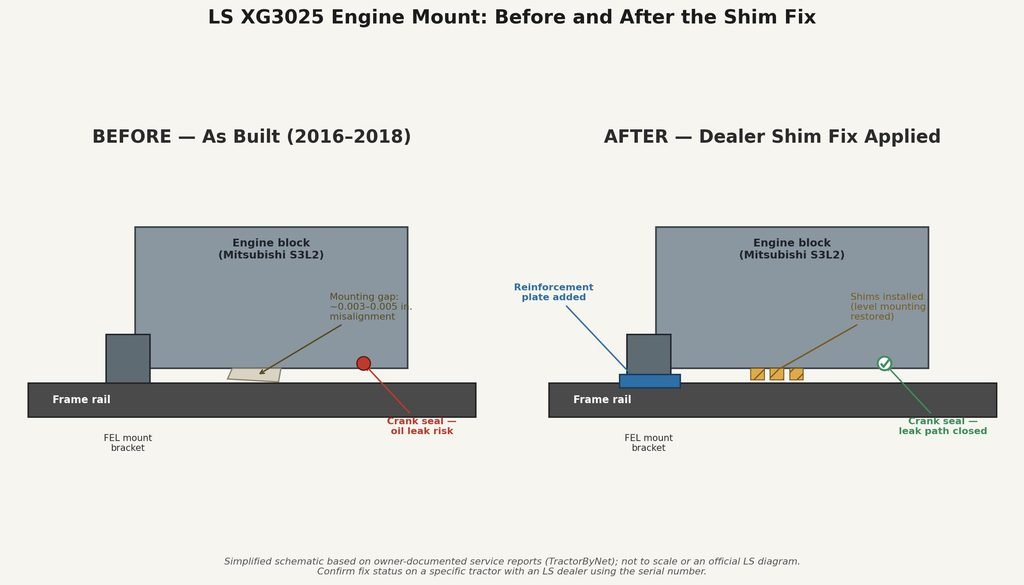
What people are almost always referring to is a service campaign LS ran on the XG3025, a compact utility tractor built roughly from 2016 through 2018 with a 24.4-hp Mitsubishi S3L2 three-cylinder diesel. The issue, described repeatedly by owners on TractorByNet, is that the engine-to-frame alignment was off by a few thousandths of an inch, which could eventually cause an oil leak at the crank seal. LS’s fix was to install shims between the engine and frame, along with a reinforcement plate at the front-end-loader mount, since the shims shifted the loader bracket slightly.
It’s a real, documented fix, and it clearly bothered enough owners that “recall” is the word that stuck. Whether it actually qualified as one depended on who you asked.
Enhancement, Upgrade, or Recall? Even LS’s Dealers Didn’t Agree
That’s not an exaggeration — it’s in the forum record. Some dealers told customers a recall had been issued and scheduled the shim work like standard warranty service. Others called it an “enhancement” or “upgrade,” pushing back specifically on the word recall. One owner reported being told the fix would only be scheduled once their tractor actually developed a leak—not ahead of time —which reads more like reactive warranty work than a proactive recall, where the norm is notifying every affected owner regardless of symptoms.
That inconsistency is probably the biggest reason this search term still pulls traffic years later. A real recall comes with defined language, a mailed notice, and a set remedy window. This didn’t have any of that structure, so owners pieced together what was happening from dealer phone calls and forum posts instead.
The Other “LS” Recall — Same Three Letters, Unrelated Company
Muddying things further, there is an actual CPSC recall with “LS” in the model name — just not this company. In 1996, CPSC and Toro jointly recalled a batch of Ford and New Holland-branded “LS 25” and “LS 45” gear-drive yard tractors over a brake-wear defect. That was a Ford/New Holland consumer lawn tractor line from the 1990s, sold under the LS name decades before LS Mtron — the Korean manufacturer behind today’s LS Tractor lineup — ever entered the U.S. market. The overlap is coincidental, but it’s exactly the kind of thing a search engine doesn’t untangle on its own, and it’s likely part of what inflates confusion around this term.
What’s Still Being Reported
Separately from the XG3025 history, BBB complaints filed through 2025 describe owners dealing with backhoe hydraulic valve and cylinder failures, with at least one customer explicitly asking LS to recall “all the tractors with the similar valve.” Based on the complaint record, LS’s response pattern has been individual warranty repairs rather than a blanket program — parts get replaced, dealers get reimbursed, but no serial-range notice goes out. Whether that’s the right call is a judgment question; as a factual matter, it means anyone searching for an official notice tied to these newer complaints won’t find one either.
None of this points to a company in trouble. LS Tractor closed a dealer-financing partnership with Mitsubishi HC Capital America in early 2026 and kept adding dealers through its 2026 farm show circuit, alongside previewing a new compact series. Growth and scattered service complaints aren’t mutually exclusive — most manufacturers, including brands generally considered more reliable, carry some version of both at once.
If You’re Checking a Used XG3025
If you’re looking at a used XG3025 from this window and want to know whether the shim fix was completed, the fastest route isn’t guesswork — it’s the serial number. LS dealers can look up service history by serial number and confirm directly whether the reinforcement work was done, since the fix was tracked through service records even without a formal recall notice attached to it. Some owners report being able to spot the shims near the engine-to-frame junction on inspection, but that’s not reliable enough to rule out on sight alone — a dealer check is the only way to know for sure.
The pattern with LS tractor recalls is less about a cover-up and more about a manufacturer that ran a legitimate fix through informal channels, then let dealers describe it however they wanted. That’s a communication problem, not evidence of a hidden defect — but it’s also exactly why the search term still doesn’t have a clean answer more than half a decade later.
A couple of things people ask
Does LS Tractor have any active recalls right now? No. There’s no CPSC-listed recall for LS Tractor or LS Mtron equipment on record. Current hydraulic complaints are being handled through individual dealer warranty claims, not a recall program.
Is the 1996 “LS 25” recall connected to LS Tractor? No. That recall involved a Ford/New Holland-branded yard tractor line from the 1990s — unrelated to the Korean-manufactured LS Tractor brand sold today.