
Tractor Transmission Fluid vs Hydraulic Fluid: Are They the Same Thing or Not?
Some links here are affiliate links — if you buy through them, Dirt Road Mechanic earns a commission at no extra cost to you. It never affects which parts or tools we recommend. Full disclosure.
The whole tractor transmission fluid vs hydraulic fluid question used to be something you’d sort out once and never think about again. But with fluid prices climbing hard this year, a lot more folks are standing in the farm-store aisle wondering whether the cheaper pail will do the same job — and that’s exactly where the expensive mistakes start. This one covers what actually separates the two, when they really are the same thing, and the single substitution that quietly kills transmissions.
Why your owner’s manual treats them like the same fluid
Pull the manual on most compact and utility tractors, and you’ll notice “transmission fluid” and “hydraulic fluid” get used almost interchangeably. That’s not sloppy writing. On the majority of machines built since about 1980, both jobs run off one shared reservoir using a single multi-purpose oil called Universal Tractor Transmission Oil — UTTO for short, or sometimes just “universal tractor fluid.” That one fluid lubricates the transmission and final drives, runs the hydraulics for your loader and three-point, feeds the power steering, and handles the wet brakes and PTO clutch, all out of the same sump. Older and collector tractors are the exception — a lot of those keep their transmission and hydraulic systems separate, and a few older geared transmissions actually call for straight GL-4 gear oil rather than a universal fluid at all — which is part of why the terminology gets muddy in the first place. On those machines, the manual, not the shared-sump rule of thumb, has the final say. And if your hydrostatic drive is already acting up, that shared fluid is the first place to look — I get into that over in the guide on hydrostatic transmission problems.
So what actually makes them different?
Here’s the part that trips people up. Plain industrial hydraulic fluid — the ISO 46 or ISO 32 stuff in a cheap pail — is built to do exactly one thing: move power through pressure. It’s got anti-wear and anti-foam additives, and that’s about it. UTTO is basically that same hydraulic base plus a whole additive package your tractor’s shared systems can’t live without: friction modifiers tuned for wet brakes and clutches, extreme-pressure additives for the gears, and a beefier anti-foam system. That’s exactly why a jug of straight hydraulic oil usually says right on the label that it’s not for transmissions, differentials, wet brakes, or final drives. Crack open your manual, and you’ll typically see a spec like API GL-4, an ISO VG 32/46 viscosity range, or a factory fill like Kubota’s Super UDT2 or John Deere’s Hy-Gard called out by name.
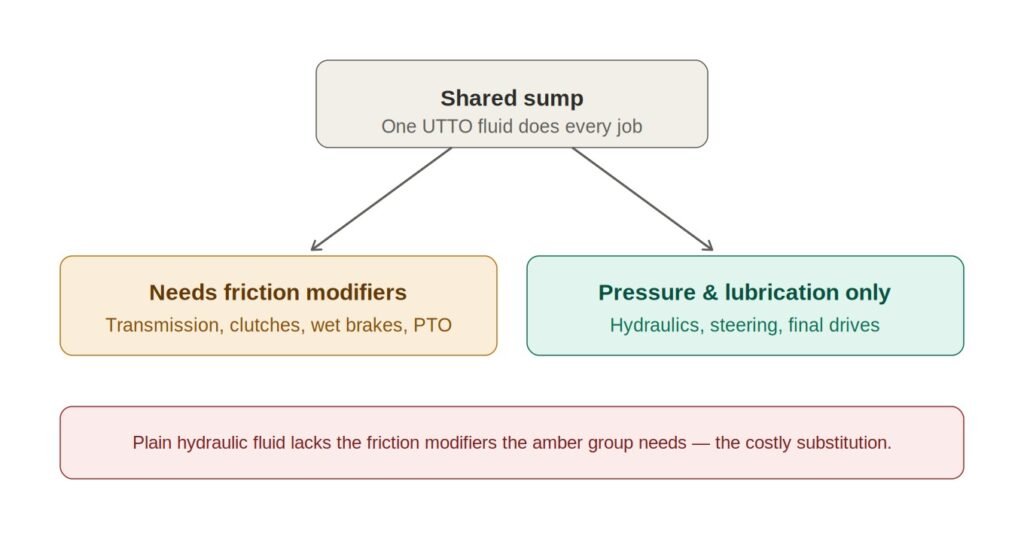
Skip those additives and things go sideways fast. There’s a well-known story floating around TractorByNet where a fellow topped off his transmission with a little #46 hydraulic oil and within half an hour the machine wouldn’t go into reverse. That’s the missing friction material talking. If you run a shared-sump machine, you want a genuine universal fluid — something like TRIAX Agra UTTO XL that meets the major brand specs, or the OEM stuff like Kubota Super UDT2 if you’d rather match the factory fill exactly. And whatever you pour in, swap the hydraulic filter at the same time — running new fluid through an old filter is money half-spent.
Here’s the side-by-side, if you’re the kind who likes it laid out plain:
| Universal tractor fluid (UTTO) | Plain hydraulic fluid (ISO 46) | |
|---|---|---|
| Main job | Transmission, hydraulics, wet brakes, PTO, steering | Moving power through pressure — hydraulics only |
| Friction modifiers (wet brakes, clutches) | Yes | No |
| Extreme-pressure additives (gears) | Yes | Minimal |
| Anti-foam / anti-wear | Heavy-duty | Basic |
| Typical viscosity | ~9.7 cSt at 100°C | ISO 32/46 (lighter) |
| Spec on the label | API GL-4, Kubota Super UDT2, JD J20C / Hy-Gard | ISO VG 32/46, anti-wear (AW) |
| Safe to swap in for the other? | Yes — can stand in for plain hydraulic fluid | No — never in a wet-brake or clutch system |
Tractor transmission fluid vs hydraulic fluid: the one rule that keeps you out of trouble
If you remember nothing else, remember this: you can run UTTO in place of plain hydraulic fluid, but never the other way around. Farmers on TractorByNet repeat that rule constantly, and it’s dead on. A universal tractor fluid already contains everything plain hydraulic oil has plus the friction and gear additives, so using it where only hydraulic oil is required does no harm. Go the other direction — dumping straight hydraulic fluid into a system with wet brakes or clutches — and you’re stripping out the exact additives those parts depend on. The more of it you add, the more you dilute what’s protecting your transmission. That’s how a $40 shortcut turns into a repair with a comma in it.
Why this is suddenly worth paying attention to
None of this is new — but the price tag sure is. Fluid has gotten a lot more expensive over the past few months as a base-oil supply crunch works its way down to the farm-store shelf, and I dug into the why-it’s-happening side of that in the piece on tractor grease. When UTTO jumps in price, the temptation to grab a cheaper generic pail gets a lot stronger. You can already see it play out on the forums — one Kubota owner posted about being flat-out shocked at UDT pricing and eyeing the half-price store-brand buckets instead. Fair instinct, but here’s the catch: plenty of guys are quick to point out that words like “Premium” and “Universal” on a jug mean nothing on their own. What matters is whether the label actually lists your tractor’s spec. A cheaper fluid that genuinely meets the standard is fine. A cheaper fluid that just looks similar is a gamble with your transmission.
What this means for you
Here’s the short version. Find your fluid spec in the manual — not the marketing on the jug — and match it exactly, whether that’s API GL-4, John Deere J20C, or a named fill like Super UDT2. If you’ve got a shared-sump machine with wet brakes or a hydrostatic drive, use a real universal tractor fluid and don’t downgrade to plain hydraulic oil to save a few bucks. Change the filter while you’re in there. And if money’s tight and you’re tempted to cut a corner, cut it in the safe direction only — a proven universal fluid that meets your spec, never straight hydraulic oil in a system that needs the additives. That’s really the whole tractor transmission fluid vs hydraulic fluid debate in a nutshell: the two overlap, but only one direction of substitution is safe. If you’re on an orange or green machine specifically, I’ve got the exact fills and capacities broken down in the Kubota hydraulic fluid and John Deere hydraulic fluid guides, plus a deeper look at what UDT2 is really for.
FAQ
Can I use hydraulic fluid instead of transmission fluid in my tractor? Only if the system has no wet brakes or clutches, and even then it’s risky. On most modern shared-sump tractors, no — plain hydraulic fluid lacks the friction modifiers those parts need. Use a universal tractor fluid (UTTO) that meets your manual’s spec instead.
Is UTTO the same as hydraulic fluid? Not quite. UTTO is a hydraulic fluid with an extra additive package — friction modifiers plus extreme-pressure and anti-foam additives — so it can also handle the transmission, wet brakes, and PTO clutch. Straight hydraulic fluid can’t do those jobs.
What happens if I put the wrong fluid in my tractor transmission? You can get clutch slip, brake chatter, gear whine, or hydraulics that won’t engage, sometimes within minutes. Drain it and refill with the correct fluid before you keep running the machine, or you risk turning a cheap top-off into a transmission repair.
What’s your take on this? Drop it in the comments.