John Deere Tractor Won’t Start: Here’s How to Diagnose and Fix It
Some links here are affiliate links — if you buy through them, Dirt Road Mechanic earns a commission at no extra cost to you. It never affects which parts or tools we recommend. Full disclosure.
Your John Deere tractor won’t start, and you’ve got work to do — that’s a frustrating combination. The good news is that most no-start problems come down to a handful of causes, and you can usually find yours in under an hour without special tools. Start with the cheap checks and work toward the expensive ones, in that order.
Specs at a Glance — John Deere 5075E (Reference Model)
| Spec | Detail |
|---|---|
| Engine | 2.9L 3-cylinder diesel |
| Battery | 12V / 623 CCA |
| Charging System | 40-amp alternator |
| Fuel Capacity | 18 gallons |
| PTO Power (tested) | 64.42 hp |
| Hydraulic System | Open center, 10–10.3 gal |
Source: TractorData.com. Specs vary by model year and configuration — always check your operator’s manual.
Step One: Figure Out What “Won’t Start” Actually Means
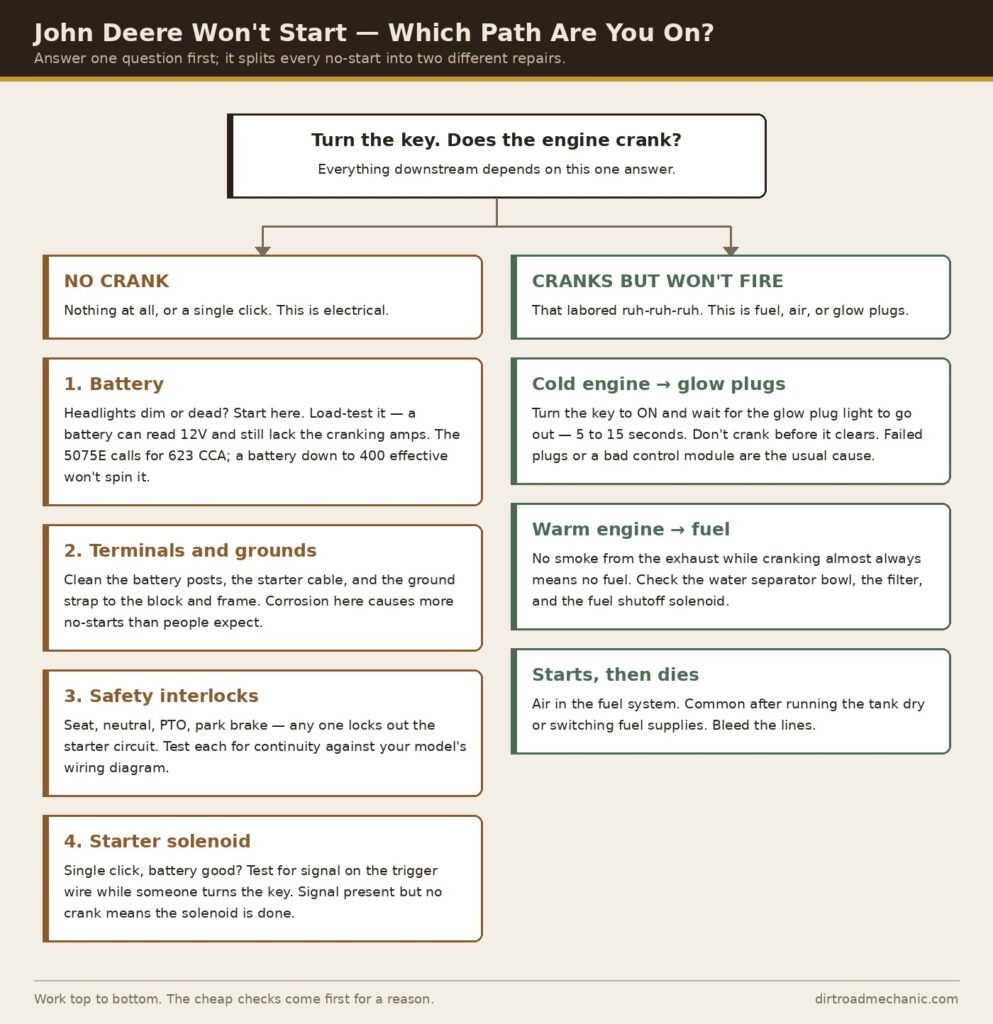
Before you do anything else, you need to answer one question: Is the engine turning over, or is it completely dead?
This isn’t just a technicality — it splits every no-start problem into two completely different diagnostic paths. If you turn the key and nothing happens — no click, no crank, no dash lights — you’re likely looking at a battery or electrical issue. If the engine cranks (you hear that labored ruh-ruh-ruh sound) but never catches and fires, you’ve got a fuel, air, or glow plug problem.
Get clear on which situation you’re in before you read further.
Dead Battery or Weak Battery
This is the single most common reason a John Deere won’t start, especially after a tractor has been sitting. A battery can show 12 volts on a meter and still not have enough cold cranking amps (CCA) to spin a diesel engine on a cold morning. The 5075E, for example, calls for a 623 CCA battery — a battery that’s worn down to 400 effective CCA won’t cut it.
What to check: Turn on the headlights. If they’re dim or don’t come on at all, start with the battery. If the lights are bright but the starter won’t engage, the battery might still be fine, and you’re looking elsewhere.
Owners on TractorByNet commonly report that a battery that “just started fine last week” can drop below the functional CCA threshold seemingly overnight, especially once temperatures dip. Load-test the battery — don’t just check voltage. A battery charger and maintainer is worth keeping in the shop for exactly this situation — it’ll bring a weak battery back and tell you whether it’s holding a charge.
Also, check terminal connections. Loose or corroded cables at the battery posts, starter, or ground strap are responsible for more no-starts than people realize. Clean them with a wire brush and snug them down before assuming the battery itself is dead.
Safety Switch Not Engaging
John Deere tractors have multiple safety interlock switches that must all be satisfied before the starter circuit will close. Common ones include the seat switch, neutral/transmission switch, PTO switch, and parking brake switch. If any one of them is faulty or out of position, you’ll turn the key and get absolutely nothing — even with a fully charged battery.
A recurring theme on TractorByNet threads is owners replacing the neutral switch, ignition switch, and starter solenoid, only to eventually discover that the PTO switch was the problem the whole time. Go through each switch methodically rather than just replacing the obvious ones.
To test: Make sure the tractor is in neutral, the PTO is disengaged, you’re seated, and the parking brake is set. If it still won’t crank, pull out a wiring diagram for your specific model and test each switch for continuity with a multimeter.
Bad Starter Solenoid
If you turn the key and hear a single click — or sometimes nothing at all — but the battery checks out fine, the starter solenoid is a prime suspect. The solenoid is the relay that sends power to the starter motor when you turn the key. They fail more often than people expect, particularly on older machines or tractors that have sat unused.
You can test whether the solenoid is getting power by using a test light on the trigger wire while a helper turns the key. If it’s getting a signal but the starter still doesn’t engage, the solenoid itself is likely toast.
Cold Weather and Glow Plugs
Diesel engines don’t have spark plugs — they rely on heat from compression to ignite fuel. Glow plugs preheat the combustion chamber to enable cold starting. If one or more glow plugs are burned out, or if the glow plug control module isn’t triggering them, the engine may crank endlessly without ever firing on a cold morning.
On MyTractorForum, owners with hard cold-start issues on John Deere compact and utility tractors repeatedly found that the fix was either failed glow plugs or a bad glow plug control module — not anything to do with fuel or the starter. The glow plugs themselves are inexpensive; the module can be pricier, but it is still a straightforward swap.
What to do: When you turn the key to the “on” position (before cranking), wait for the glow plug indicator light to go out — this typically takes 5–15 seconds depending on temperature. Many people skip this step, especially if they’ve always had gas engines. Don’t crank until that light clears.
If your tractor has an intake air heater instead of traditional glow plugs (some older JD models), you’ll push and hold the key inward after turning to the run position. Check your operator’s manual.
Fuel Delivery Problem
If the engine turns over normally but won’t fire — and the glow plugs check out — the next step is fuel. Common culprits include a clogged fuel filter, water in the fuel (diesel is prone to water contamination), a failed fuel shutoff solenoid, or air in the fuel lines after running the tank dry.
On TractorByNet threads about the JD 5310 series, a failed fuel shutoff solenoid turned out to be the root cause when the engine would crank with no smoke from the exhaust — a classic sign of no fuel reaching the cylinders. No smoke while cranking on a diesel almost always means no fuel.
Drain and inspect the water separator bowl on your fuel filter assembly. If you’ve recently run the tank low or switched fuel supplies, you may also need to bleed the fuel system of air.
Corroded or Loose Ground Connections
Ground faults are an underestimated cause of intermittent no-start behavior. A poor ground can cause weak cranking, solenoid clicks, or a starter that works sometimes and not others. Trace the ground strap from the battery to the engine block and the frame. Any corrosion or looseness there can mimic a bad battery or bad starter.
John Deere Won’t Start — Quick Diagnostic Summary
| Symptom | Most Likely Cause |
|---|---|
| Nothing happens, no lights | Dead battery, blown fuse |
| Lights work, no crank | Safety switch, solenoid |
| Single click, no crank | Weak battery, bad solenoid |
| Cranks but won’t fire (cold) | Glow plugs or module |
| Cranks but won’t fire (warm) | Fuel shutoff, clogged filter |
| Starts, then dies | Air in fuel, fuel delivery |
Work through these in order, and you’ll find the problem without spending money on parts you don’t need. In most cases it’s the battery, a safety switch, or the glow plugs — and all three are within reach of anyone with a wrench and an hour.
Have a different symptom? Drop it in the comments.