Tractor DPF Regen Problems: Is Your Tractor Broken or Just Bored?
Some links here are affiliate links — if you buy through them, Dirt Road Mechanic earns a commission at no extra cost to you. It never affects which parts or tools we recommend. Full disclosure.
Tractor DPF regen problems hit compact tractor owners harder than anyone, and the reason has more to do with how the tractor gets used than how it was built. A diesel particulate filter only cleans itself passively when the exhaust runs around 1,100°F, and mowing a couple of acres, idling between loader jobs, and shutting down after 20 minutes never gets it that hot. The soot keeps piling up, and the tractor starts asking for help.
First, Make Sure Yours Has One
Not every diesel tractor carries a DPF. Under EPA’s Tier 4 Final rules, engines under 19 kW (about 25 hp) are allowed 0.4 g/kWh of particulate, while the 19–56 kW class is held to 0.03, per DieselNet’s summary of the standards. That gap is why most sub-25 hp compacts don’t have a filter at all. Above that line, most do, but Kubota launched a set of 19–56 kW engines in 2015 that met Tier 4 with only a diesel oxidation catalyst. A regen switch on the dash or a regen light on the cluster settles the question fast.
Auto, Parked, and Service Regens Are Different Animals
Kubota’s L3301 operator’s manual lays out the basic auto mode: the regeneration indicator flashes, and you keep working while raising engine speed whenever the engine rpm increase indicator tells you to. Wickham Tractor, a Kubota dealer, puts the lights simply: flashing means a regen is needed, solid means one is running, and off means it’s done. The same dealer says most machines need one every 15 to 20 hours, some stretch to 50, and a parked regen takes about 20 minutes, up to 40 on certain models. Ignore it long enough, and the warnings climb through four PM levels, the last one calling for service.
The parked regen is where people get burned, sometimes literally. Exhaust and hood temperatures run hot enough that Alpine Equipment tells owners to park well away from dry grass, fuel, or anything flammable. That’s what the inhibit switch is for: holding off a regen while you’re in a hayfield, a barn, or tall dry brush. Shutting the key off halfway leaves the soot right where it was.
A service or recovery regen is the last resort when the filter is too loaded for the other two, and it usually means dealer software.
When It Wants a Regen Every Few Hours
One LS owner on TractorByNet traded an MT3 42 for an MT3 57 and logged four regens in his first 16 hours. His old tractor had done two in 127. “I am using more fuel for regening than actually working,” he wrote. Replies pointed at the DPF differential pressure sensor, which reads the pressure across the filter and can call for regens that aren’t needed. In his case, it settled down on its own to roughly every 20 hours once the tractor passed 400 hours. See our LS tractor problems roundup for more.
On older machines, the suspect changes. Soot burns off in a regen. Ash, left behind by additives in engine oil, never does. It builds over thousands of hours; for John Deere PowerTech engines under 175 hp, the interval between ash removals runs 3,000 to 8,000 hours, according to Lift and Access. Oil matters here. API CK-4 and the older CJ-4 both cap sulfated ash at 1%, per Chevron, so use what your operator’s manual specifies and don’t top off a DPF tractor with whatever diesel oil happens to be on the shelf.
The Fuel Side Can Stop a Regen Cold
Some systems use fuel to heat the filter, and that fuel path clogs like any other. A Massey Ferguson 1739E owner on TractorByNet had the regen and hot exhaust lights stay on for hours without the cycle ever finishing. The cause was a gummed-up inline fuel filter (part 4268939M91) starving the regen burner, and he replaced the main fuel filter cartridge (7067436M1) along with it. He later found debris in the burner’s injector ports too. Our guide to tractor fuel system problems covers the basics.
Another owner, with a 2014 MF 1734E at 879 hours, waited nearly three weeks while the dealer chased a regen that wouldn’t finish and threw no codes. The verdict was damaged DPF injectors plus a manual filter cleaning. “Not even 1000 hours yet. Absolutely pathetic,” he wrote, and he planned to trade it for a pre-Tier 4 tractor. See also our list of Massey Ferguson tractor problems.
Costs climb fast once it gets that far. Alpine Equipment puts off-machine cleaning at $300 to $1,000 and a replacement filter at $2,500 and up. A former Kubota B3350 owner on OrangeTractorTalks said his own repairs would have run $7,000 to $9,000 without warranty coverage. Our Kubota tractor repairs guide covers the rest.
Deletes, Right to Repair, and What Changed in 2026
Forums are full of delete kits and modules that fake out the sensors. Pulling a DPF is still illegal under the Clean Air Act. In January 2026, the Justice Department said it would stop bringing criminal charges for emissions tampering, but civil enforcement stays on the table.
The bigger change for owners came on February 3, 2026, when EPA said the Clean Air Act lets owners and independent shops temporarily take equipment out of its certified setup to diagnose and repair it. Deere answered by promising a temporary inducement override through Operations Center PRO Service, though inducements are the SCR and DEF power cuts, not DPF regens. Deere’s $99 million right-to-repair settlement, reached in April 2026, also requires it to share diagnostic tools for its large ag equipment for 10 years, and claims are due December 31, 2026.
Most of the other 2026 emissions headlines are DEF news, not DPF. EPA dropped the DEF quality sensor requirement in March and proposed swapping SCR derates for audible warnings in July. Neither one changes how your particulate filter works.
Where to Start When the Light Comes On
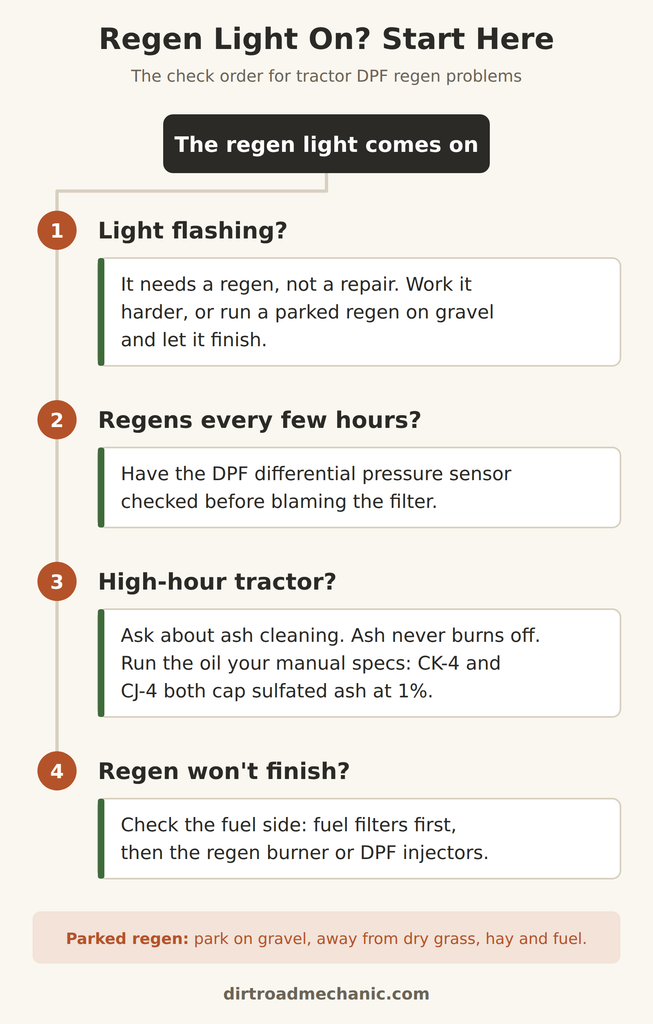
- Read the indicator. Flashing means it needs a regen, not that something is broken.
- Work it harder, or run a parked regen on gravel and let it finish.
- If regens come every few hours, have the differential pressure sensor checked before blaming the filter.
- On a high-hour tractor, ask about ash and check the oil spec.
- If a regen won’t complete at all, look at the fuel side, filters first.
Most tractor DPF regen problems come down to soot that never got hot enough to burn, and the fix is usually in how the tractor gets worked rather than in a new filter.