Tractor 3-Point Hitch Problems: Won’t Lift or Won’t Drop
Some links here are affiliate links — if you buy through them, Dirt Road Mechanic earns a commission at no extra cost to you. It never affects which parts or tools we recommend. Full disclosure.
A three-point hitch that won’t cooperate can shut down a whole day’s work. The complaints are the same whether you’re running a John Deere, a Kubota, or a Mahindra: it won’t lift, it creeps down on its own, or it’s stuck up and won’t drop. Most of the time the cause is one of a handful of things, and you can narrow it down before you open anything up.
The Maintenance Gap Behind Most Hitch Failures
Hydraulic systems on compact and utility tractors share fluid between the transmission, the loader, and the hitch. When that fluid gets dirty, or the filter starts to plug, the three-point is usually the first thing to slow down — it’s last in line for pressure priority on most open-center systems. A lot of hitch complaints trace back to fluid that’s been in there through a season of loader work and never changed. If you’re not sure when your hydraulic fluid was last changed, our tractor hydraulic repair guide covers the full service process.
The Loader Test: The Diagnostic Shortcut Nobody Writes About
Before you start pulling anything apart, do this one thing first: raise your front-end loader.
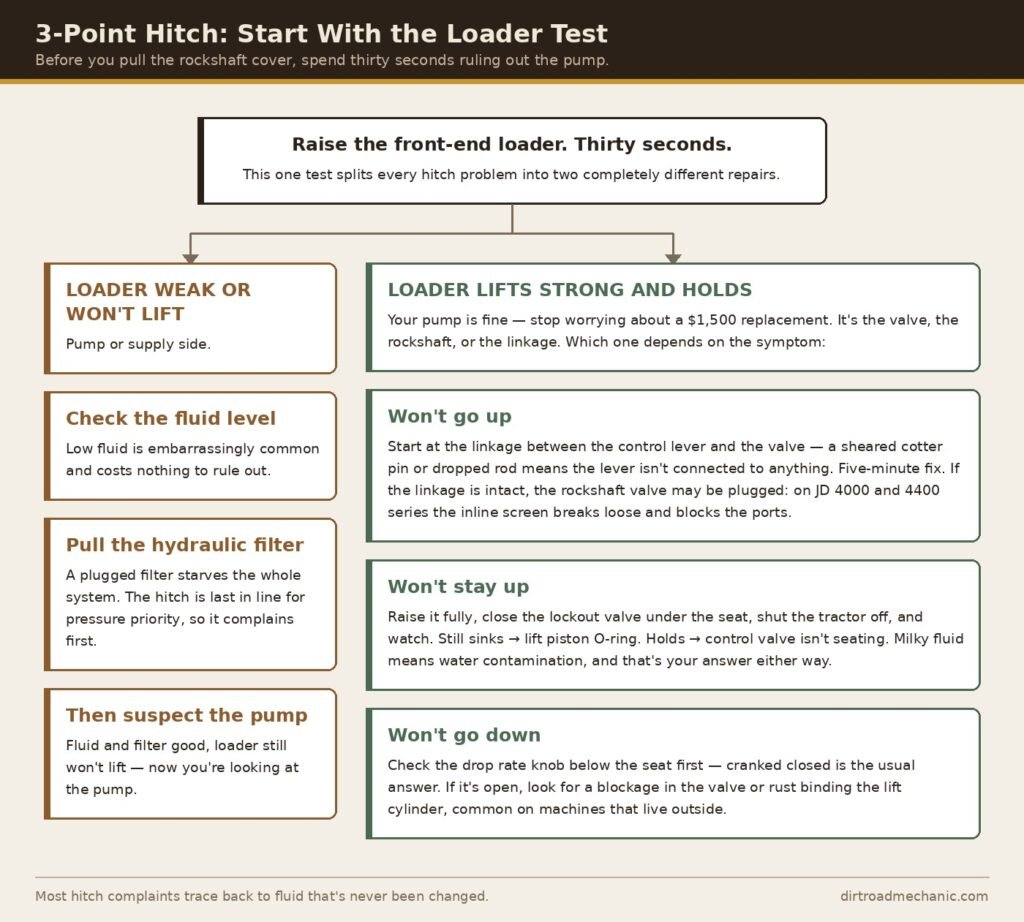
If the loader goes up strong and holds position, your hydraulic pump is fine. You can stop worrying about a $1,500 pump replacement right now. What you have is either a bad control valve, a rockshaft issue, or a mechanical linkage adjustment that’s out of spec. That’s still work, but it’s a completely different repair path.
If the loader won’t go up — or goes up weak and slow — then you do have a pump or supply problem. Check your fluid level first (low fluid is embarrassingly common), then pull the hydraulic filter. A plugged filter will starve the whole system. If the fluid and filter check out and the loader still won’t lift, now you’re looking at the pump itself.
Farmers on TractorByNet have been circling back to this exact test in recent threads. One guy with a JD 5065E described spending two weekends chasing a 3-point hitch problem that wouldn’t lift his mower — the loader worked fine, the fluid was full — and eventually traced it to a draft control adjustment rather than anything mechanical. The pump was never the problem.
Don’t skip the loader test. It splits every 3-point hitch problem into one of two buckets in about 30 seconds.
Three Symptoms, Three Different Fixes
Every hitch complaint falls into one of three symptom buckets. Each one points to a completely different fix.
Won’t go up. If the hitch lies there dead with no movement at all, and your loader works fine, start with the linkage between the control lever and the valve. A cotter pin shears, a rod falls out, or the connection between the lever and the rockshaft control valve gets knocked loose — and suddenly, moving the lever does nothing because it’s not actually connected to anything. This is a five-minute fix if that’s what it is. If the linkage looks intact, the rockshaft control valve itself may be stuck or have debris in it. On older John Deeres in particular, the inline filter screen inside the rockshaft valve housing is known to break loose and plug the valve ports — a common find on 4000 and 4400 series tractors.
Won’t stay up. The hitch raises fine but slowly sinks under load or even at rest. This is almost always a seal issue — either the lift piston O-ring is leaking internally, or the control valve isn’t seating and holding pressure. To figure out which, raise the hitch all the way and close the lockout valve (usually located right under the seat). Shut off the tractor and watch. If the hitch still sinks with the lockout valve closed, you’ve got a bad lift piston O-ring. If it holds with the lockout valve closed, your control valve is the culprit. Water contamination in the hydraulic fluid is another cause — if you’ve got milky-looking oil, that’s your answer right there.
Won’t go down. A hitch stuck in the up position is often a drop rate adjustment knob cranked all the way closed — check the knob below the seat before doing anything else. If the adjustment is open and it still won’t drop, you may have a blockage in the valve system or rust binding the lift cylinder. A MyTractorForum member with an older Kubota B7200 described this exact situation — the cylinder had surface rust at the top of its travel from sitting outside, and the piston was physically binding. A ball hone fixed it.
3-Point Hitch Problems by Brand
A common concern on MyTractorForum and TractorByNet is that the same symptom hits differently depending on what you’re running.
John Deere compact and utility tractors — particularly the 4000 series — have a known issue with the bronze inline filter screen inside the rockshaft valve breaking loose over time. The screen debris ends up in the valve ports and kills the hitch function. The fix is disassembling the rockshaft control valve and cleaning it out, rather than automatically replacing it. For a broader John Deere hydraulic and maintenance context, our John Deere tractor repair guide covers the full picture.
Kubota owners tend to run into the “won’t lower” problem more than anything. The drop rate adjustment knob is the first thing to check. Beyond that, B-series and L-series machines can develop binding in the lift cylinder from moisture contamination — especially on machines that live outside. Our Kubota repairs guide has more on Kubota-specific hydraulic issues.
Mahindra forum threads lean toward hydraulic fluid issues and linkage adjustments. The 2015 HST is a common thread topic, with owners reporting the 3-point suddenly becoming very stiff to raise, usually a fluid level or binding linkage issue rather than anything internal. See our Mahindra tractor problems guide for more on the Mahindra hydraulic situation.
Before You Pull the Rockshaft Cover
If your 3-point hitch is giving you trouble, here’s the order of operations before you call a dealer:
Start with fluid and filter. A clean hydraulic filter and fresh fluid fix a surprising number of 3-point hitch problems. For Kubota machines, Kubota Super UDT2 is the factory-spec fluid. John Deere owners should stick with John Deere Hy-Gard. If you’re running a mixed fleet or a brand that uses a universal trans-hydraulic fluid, TRIAX Agra UTTO XL covers a wide range of specs. Keep a WIX 51372 hydraulic filter on the shelf if you’re running Kubota.
Do the loader test. Takes 30 seconds and tells you whether you’re chasing a pump problem or a valve/linkage problem.
Check the obvious mechanical stuff. Inspect the linkage between your lift lever and the control valve — pins, rods, and cotter pins. If you’ve got stuck or seized linkage components, soak them with PB Blaster penetrating oil before you start forcing anything. It’ll save you broken bolts and a lot of headaches.
Pressure test before buying parts. If you want to know whether your pump is actually producing adequate pressure, a hydraulic pressure test gauge kit takes the guesswork out of the diagnosis. Knowing actual system pressure is worth more than guessing your way through $400 in parts.
If this job uncovers broader hydraulic issues, our farm equipment maintenance guide has a full section on hydraulic system care across all brands.